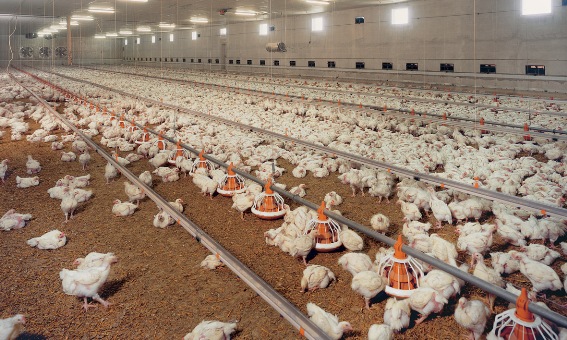

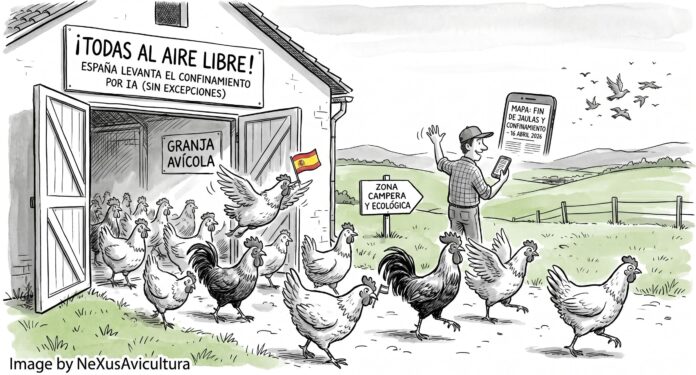
Spain fully lifts the AI confinement order for absolutely all poultry farms.
- The lifting applies to the whole of Spain and without exception, allowing birds to regain outdoor access and return to normal management practices, particularly in free-range and organic systems.
- The return to normality reinforces consumer confidence in a context of rising demand, as household egg consumption in Spain increased by 3% in 2025 (Jan–Nov) compared with the previous year.
- Alongside this return to normal management, the sector is fully engaged and committed to the transition towards cage-free systems, with growth of 10.25% over the past year.
Madrid, 16 April 2026. – The Ministry of Agriculture, Fisheries and Food (MAPA) today decreed the unconditional lifting of poultry confinement across the whole of Spain, following an improvement in the assessed risk of transmission from wild birds to domestic poultry, in accordance with the technical analysis of the situation. Under the partial lifting of 1 April 2026, a total of 1,201 municipalities had remained subject to the outdoor access ban (until today).
The measure allows birds normally kept outdoors to return to yards and paddocks, resuming their usual management, with particular impact on free-range and organic systems.
INPROVO (Organización Interprofesional del Huevo y sus Productos) has welcomed the news very positively, as it represents a return to normality for farms and for the birds themselves. “Regaining outdoor access is important for the day-to-day management of many holdings and restores normality to the sector’s daily operations,” said Luz de Santos, Director of INPROVO.
The association further underlines that this decision also conveys a message of confidence and stability to consumers. The sector operates according to technical criteria, with controls and biosecurity measures designed to ensure food safety and continuity of supply. In this context, INPROVO notes that household egg consumption rose 3% in 2025 (January to November) compared with the previous year, reflecting a positive trend in demand and the egg’s role as an essential item in the shopping basket.
The organisation also places this decision within a context of sustained progress towards alternative production systems. The sector continues to strengthen cage-free models, whose share has grown steadily to reach 40% of the total flock. Over the past year, production under these systems has grown by 10.25%, reflecting the sector’s commitment to transforming its production model in response to new market and societal demands.
Finally, INPROVO recalls that confinement was a preventive, health-related and temporary measure, and that its removal has been carried out by the competent authorities in an orderly manner based on technical criteria. Avian influenza can affect various bird species; it is therefore essential to maintain and reinforce biosecurity measures on farms to minimise contact between wild and domestic birds, and to report any suspicion immediately to the official services.
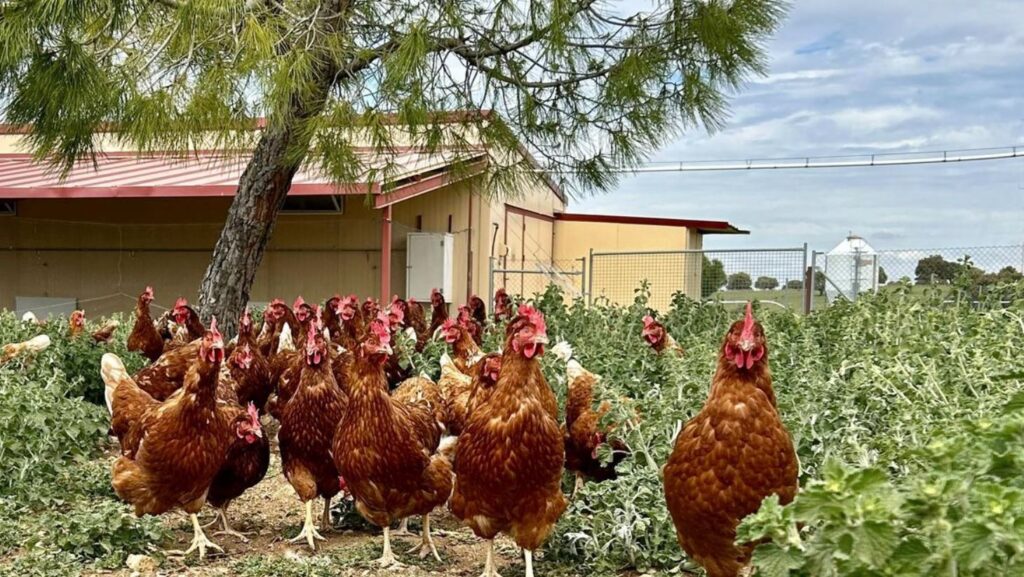
Spain has held the status of a country free from avian influenza since February 2026, as granted by the World Organisation for Animal Health (OMSA), which removes all restrictions on the movement of birds and their products.
Despite the lifting of the confinement order, MAPA stresses that biosecurity measures must be maintained on holdings, avoiding contact with wild birds and reinforcing passive surveillance. In the event of any clinical suspicion, farms are urged to notify the official veterinary services immediately.
An annus horribilis for poultry health that has raised new questions: Vaccinate? Confine? Yes or no, and for how long?
Since 1 July 2025, 16 avian influenza outbreaks have been recorded on commercial poultry farms in Spain, with the most recent on 13 January in Lleida. In total, the sector culled nearly 3 million farm birds in 2025, the highest figure ever recorded in the country from this cause.
Outbreaks were geographically concentrated along the Valladolid–Toledo–Lleida corridor, with a particularly severe impact on laying hen operations: the farm at Villalar de los Comuneros (Valladolid), with 760,000 hens, and that of Bellpuig (Lleida), with 235,000, illustrate the devastating potential of a single outbreak.
Avian influenza also affected wild birds with unprecedented intensity: 165 outbreaks reported since July, plus six in captive birds.
The five-month confinement, criticised by parts of the sector as excessive, the sustained health pressure, and the production losses have left their mark on a year the sector will not soon forget.
Sources:
-. BOE Thursday 16 April 2026: Orden APA/338/2026, de 15 de abril, por la que se deja sin efectos la Orden
APA/1288/2025, de 11 de noviembre, por la que se establece la medida de confinamiento de explotaciones para la prevención y control del contagio por influenza aviar.
-. Inprovo, MAPA and own sources
Further reading:
-. Avian Influenza on NeXusAvicultura
-. Mandatory confinement in Spain
-. News on Vaccination of poultry farmers and personnel in contact with production birds to prevent zoonosis risks.
-. News on Vaccination of production birds to prevent AI outbreaks
Want to stay one step ahead in poultry farming?
Subscribe free to our eNewsletter and receive a weekly selection
of the best information to anticipate trends, stay up to date, and grow as a poultry industry professional.
NeXusAvicultura: Vision, Insight, Quality and Context.