
NeXusAvicultura | News and analysis | April 2026
The lifting of the mandatory housing order for all poultry in England and Wales on 9 April lasted barely 48 hours without incident: a first case was confirmed on 11 April, and two more were added on the 14th, in Lincolnshire and Cambridgeshire.
On 2 April 2026, the United Kingdom’s Department for Environment, Food and Rural Affairs (Defra) announced the lifting of the mandatory housing measures for poultry in England and Wales with effect from 9 April. The decision, supported by the best available epidemiological evidence, brought to an end an order that had been in force across the whole of England since 6 November 2025 — more than five months of continuous indoor housing.
The return to normality was short-lived. On Saturday 11 April — two days after birds were permitted to return outdoors — the first outbreak was confirmed on a unit of breeding ducks near Market Rasen, in Lincolnshire. On 14 April, two further cases were reported: one in South Cambridgeshire involving pheasants, and another in West Lindsey (Lincolnshire), again in breeding ducks. In total, three HPAI H5N1 foci in less than one week.
Five and a half months of mandatory housing
The housing order came into force on 6 November 2025 in response to a deteriorating epidemiological situation in wild bird populations. During this period, the risk to domestic poultry was assessed as high to medium, with environmental viral pressure from migratory waterfowl that, according to the latest EFSA quarterly report, was the highest recorded in Europe over the past five years.
Across the United Kingdom as a whole, the 2025–2026 season recorded 95 confirmed HPAI H5N1 outbreaks prior to the lifting of the order (75 in England, 9 in Scotland, 7 in Wales and 4 in Northern Ireland), a figure higher than the two preceding seasons though still well below the peak of 207 cases recorded in 2022–2023.
The decision to lift the order was underpinned by a risk assessment showing a reduction in the level of threat in wild bird populations. Nevertheless, the authorities kept in place the Avian Influenza Prevention Zone (AIPZ), with its stringent mandatory biosecurity protocols: disinfection of footwear, clothing, vehicles and equipment before and after accessing premises.
The UK’s Deputy Chief Veterinary Officer, Jorge Martin-Almagro, was explicit in his statement: although the risk to poultry had decreased, the possibility of new infections persisted, and poultry keepers were required to maintain rigorous biosecurity and remain on high alert. Wales’s Chief Veterinary Officer, Richard Irvine, stressed that the virus had not disappeared.
Three outbreaks in less than a week: the sequence of events
The first post-lifting positive was confirmed on 11 April on a unit of breeding ducks near Market Rasen (West Lindsey, Lincolnshire). The fact that these were birds typically reared indoors — not linked to the newly permitted outdoor access — did not allay concern within the sector. The presence of the virus so soon after the order was lifted made it clear that its circulation in the environment had not ceased.
On 14 April, the second and third cases were reported. The Cambridgeshire outbreak affected pheasants on a commercial holding near Great Shelford (South Cambridgeshire). The third, again in Lincolnshire, was located near Gainsborough (West Lindsey) and also involved breeding ducks. The geographical concentration along the Lincolnshire–Cambridgeshire corridor — an area of high poultry farm density and a major migratory waterfowl flyway — has not gone unnoticed.
Two outbreaks in Lincolnshire and one in Cambridgeshire in less than 72 hours.
The geography of the outbreak coincides with one of the regions of
highest poultry density in England
and
with active migration routes.
In all cases, the authorities activated standard control protocols: a 3 km protection zone and a 10 km surveillance zone around each outbreak, humane culling of all birds on affected premises, and a requirement to house birds on farms falling within those zones.
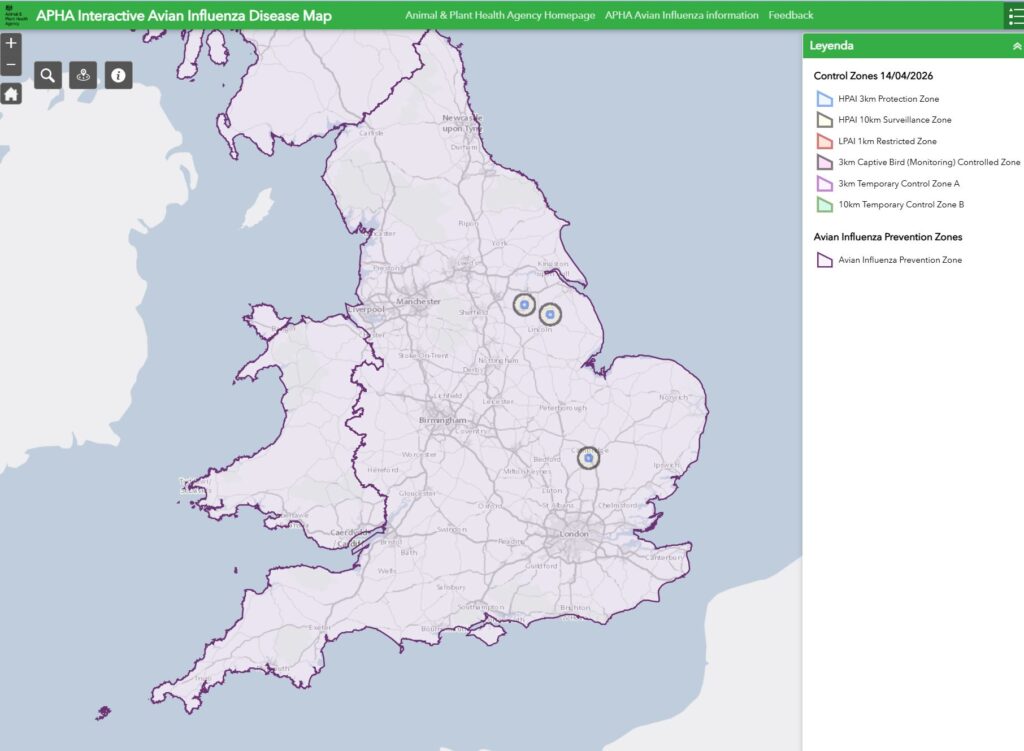
To view the real-time situation, access this DEFRA interactive map
The tension between free-range and biosecurity
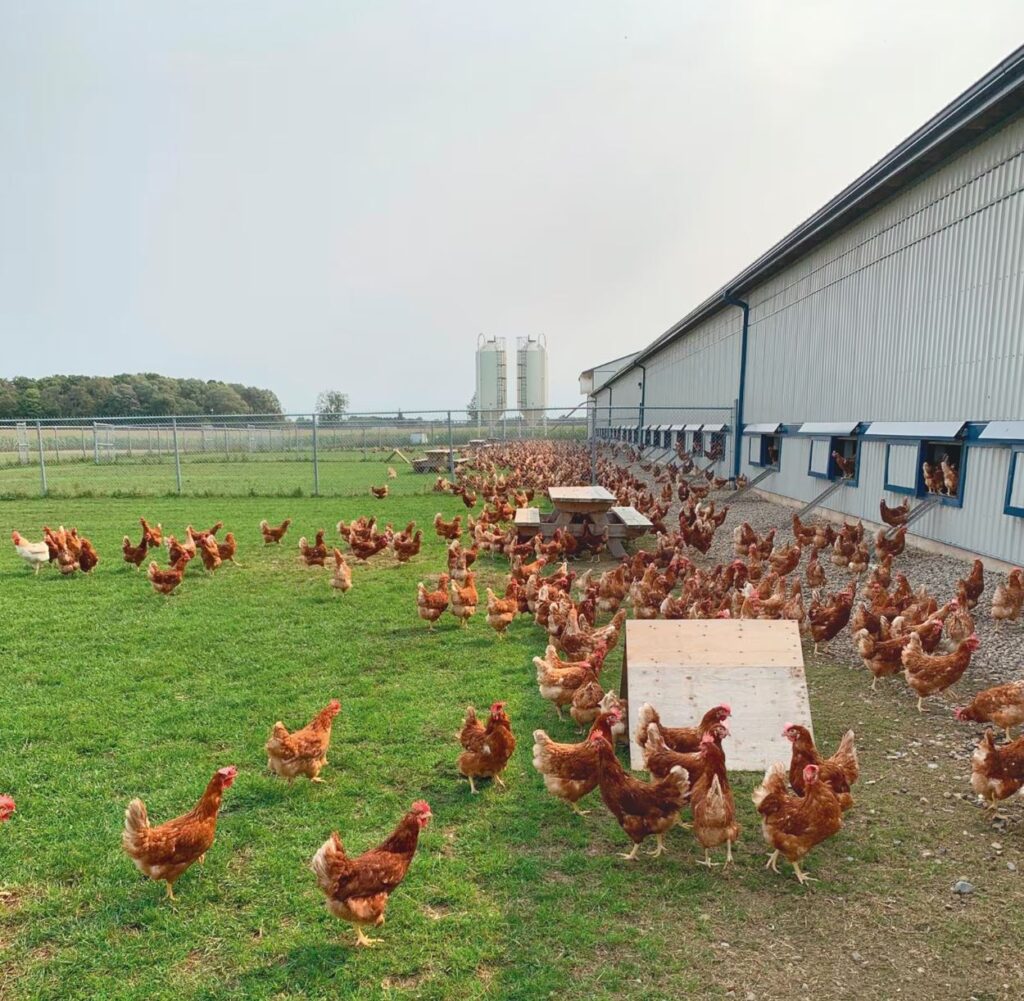
The news comes at a particularly sensitive time for free-range egg and free-range chicken producers in the United Kingdom. Many of them had only just begun to manage the return of their birds to the outdoors — following Defra’s guidance on preparing outdoor areas, disinfecting hard surfaces, removing standing water and reinstating wild bird deterrents — when the new positives were announced.
For free-range and outdoor egg producers, the equation is structurally challenging: outdoor access is a defining requirement of the production category, yet it simultaneously entails a greater risk of exposure to the virus in environments where wild bird pressure remains high. Compliance with labelling standards — and the ability to maintain certification — depends on animals having effective outdoor access, yet the authorities may order a return to housing if the situation demands it.
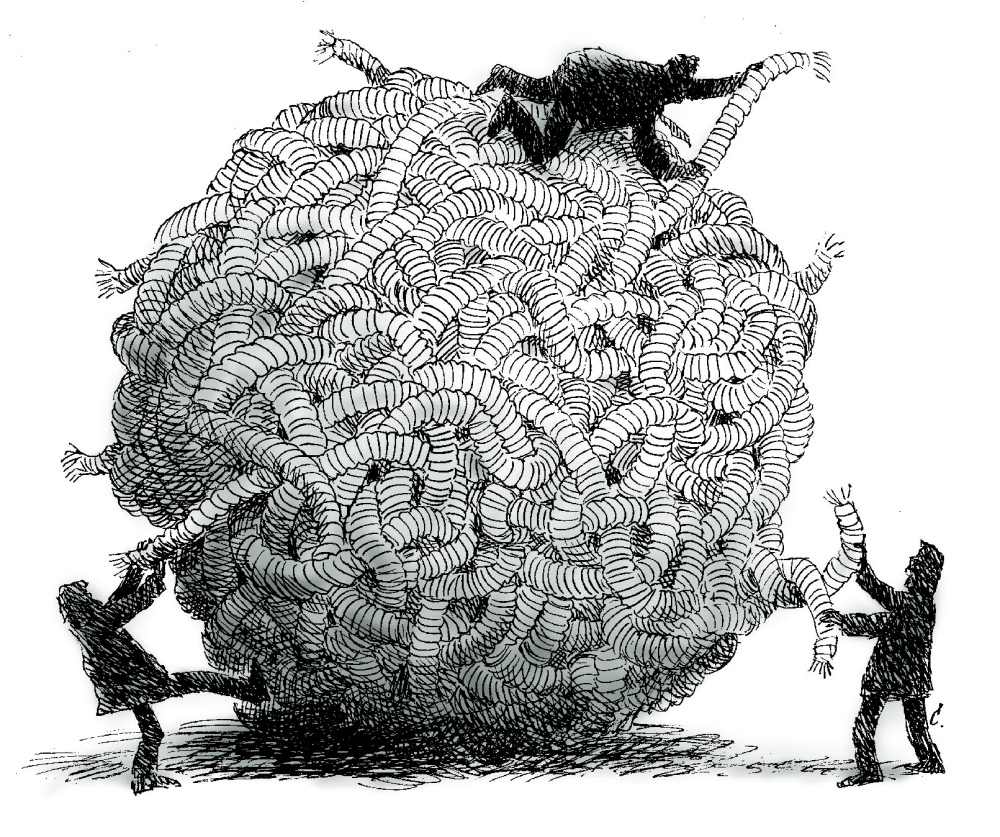
Defra currently assesses the risk to poultry as ‘low’ where robust biosecurity is in place, but ‘medium’ for wild birds. This asymmetry between the risk in wild bird populations and the risk on farm is precisely the Gordian knot that the sector has been unable to cut for years.
The current situation at a glance
| SUMMARY SHEET: HPAI IN THE UNITED KINGDOM — APRIL 2026 | |
| Country | United Kingdom (England and Wales) |
| Housing order lifted | 9 April 2026 |
| Housing order start date | 6 November 2025 (5 months and 3 days) |
| Confirmed subtype | HPAI H5N1 |
| Outbreak 1 (11 Apr.) | Breeding duck unit. Market Rasen, West Lindsey, Lincolnshire |
| Outbreak 2 (14 Apr.) | Commercial pheasants. Great Shelford, South Cambridgeshire |
| Outbreak 3 (14 Apr.) | Breeding ducks. Gainsborough, West Lindsey, Lincolnshire |
| Measures activated | Protection zones (3 km) and surveillance zones (10 km). Humane culling. Housing requirement within zones |
| UK cases 2025/26 season | 99 confirmed (75 Eng. / 9 Scot. / 7 Wal. / 4 N.Ire.) |
| Current risk (Defra) | Low for poultry with biosecurity in place; Medium for wild birds |
This has been the harshest winter in Europe in five years
The new outbreaks in the United Kingdom are not an isolated phenomenon. The latest EFSA quarterly report covering the 2025–2026 winter documented 289 outbreaks in poultry across 18 European countries, with nearly 16 million birds culled — a 27% increase on the previous quarter. The United Kingdom was the fifth most affected country in the EU/EEA with 25 outbreaks during the period analysed.
The environmental viral load from migratory birds reached unprecedented levels over the past five years during that same period, with the H5N1 clade 2.3.4.4b virus firmly established in populations of ducks and other waterfowl. Although 82% of outbreaks on holdings were attributed to independent introductions from wild birds — rather than farm-to-farm transmission — the situation highlights that containment measures at farm level continue to be insufficient in the face of environmental pressure of this magnitude.
A premature lifting?
The sequence of events has reopened the debate about the criteria used to decide when to lift housing measures. The British poultry sector, which had kept birds housed for weeks, needed the restrictions to be lifted: animal welfare, operational costs and compliance with outdoor production standards all demanded it. Yet the new positives, which emerged almost immediately, raise the inevitable question: was the decision premature?
The answer is that there is no perfect moment while the virus is actively circulating in wild bird populations. Defra’s risk assessment did not disregard this context: it maintained mandatory housing, required strict biosecurity and warned that the risk had not disappeared. However, the predictive capacity of these systems has its limits when the wild reservoir is as extensive and dynamic as it currently is.
From the start of the 2025–2026 season in October 2025 through to the date the order was lifted, 99 cases of avian influenza had been confirmed in the United Kingdom — above the two preceding seasons — placing the country in a position of permanent vigilance that shows no sign of being resolved in the near term.
Further reading:
-. Poultry industry in the United Kingdom
-. Avian Influenza and mandatory housing on NeXusAvicultura
-. News on Vaccination of poultry farmers and personnel in contact with production birds to mitigate zoonosis risks.
-. News on Vaccination of production birds to prevent AI outbreaks
Want to stay one step ahead in poultry?
Subscribe free to our eNewsletter and receive a weekly selection
of the best information to anticipate trends, stay up to date and grow as a poultry professional.
NeXusAvicultura: Vision, Judgement, Quality and Context.