
Interview with Gerard Llamas, the new President of the Associació de Criadors de la Raça Prat
“It is raised in the region in a very traditional way and has impressive culinary qualities”
“It is an absolutely local breed that has not remained confined to a domestic setting, but has been exported all over the world”
Rosa M. Bravo – El Prat de Llobregat
Gerard Llamas, 27 years old, is the new president of the Associació de Criadors de la Raça Prat, the indigenous chicken of El Prat de Llobregat, also known as “pota blava” (or blue leg) due to the characteristic colour of its legs. He has taken over from Valentina Guisado, who presided over this organisation for 30 years, dedicated to promoting and preserving the breed.
Does this change of presidency reflect a desire for generational renewal?
It was more a matter of chance than planning. My partner’s great-aunt is Valentina Guisado. Valentina explained to me the situation of the organisation, what is being done and what needs to be done, and in the end I decided to join, learn as much as I could, and now I am leading it in place of Valentina.
What makes this breed special?
It is special because of its identity. Although its golden age was mainly during the first third or first half of the 20th century, and it has had its ups and downs during part of the 21st century, it is a breed that has been talked about for many centuries. We have evidence that in the 13th century several wealthy families and feudal lords of Barcelona were already purchasing chickens from the Llobregat delta, which had unique characteristics in terms of meat, size, and production within Catalan territory.
Brought about by the particular conditions of the Llobregat delta?
Also by the work of the farmers. We cannot understand the Llobregat delta without its climate and land characteristics, but neither without its farmers, who have modified the geography and the soil to achieve highly specialised production. The Catalan breed from El Prat that we know today, the blue leg, emerged from hybridisation with Asian breeds. It experienced a spectacular boom during the 1930s and 1940s. In 1932, the Granja Avícola Prat was established, led by Josep Bofarujas and Rosa Álvarez. It was the first conventional farm of the Prat breed and exported chicken everywhere, to the point that breed populations existed on the American continent.
Could it be said that the term ‘Prat breed’ emerged at that point?
Perhaps a little earlier, at the beginning of the 20th century, but it became popular from the 1930s onwards. The Granja Avícola Prat closed in 1961, and Rosa Álvarez founded our association in 1985 and presided over it. The Prat breed has an enormous territorial identity. First, because it is free-range poultry born exclusively in the Llobregat delta and in El Prat — an absolutely local breed that gives identity to an entire town. And also because it has not remained confined to a domestic setting, but has been exported all over the world.
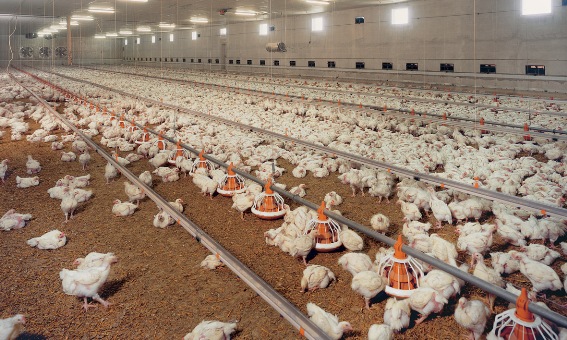
The Les Salines secondary school has a farm where students carry out practical work as part of their vocational training courses
And when it comes to cooking, what are its particular characteristics?
Its meat is very firm and very fibrous, but it also has a very interesting touch of fat. To draw an analogy, it would be like wild boar compared to pork. It is not the same chicken you find in a supermarket; it is raised in the region in a very traditional way and has impressive culinary qualities.
This chicken holds Protected Geographical Indication (PGI) status, a European quality seal.
Yes, mainly because very clear criteria have been established for the rearing of both the chicken and the capon — a castrated, overfed adult cockerel that can reach five or six kilograms, while the chicken weighs between two and a half and three and a half kilograms.
What requirements does PGI rearing entail?
You can keep the Prat breed without complying with the PGI. The PGI is primarily aimed at free-range poultry destined for conventional food service. For example, the only farm that complies with the PGI for the Prat breed is Granja Torres. In the town there are small breeders, but on a self-consumption basis. They do not sell; to do so, they would need to scale up the operation to make it viable.
Many breeders with backyard flocks for personal consumption are retired farmers who cannot find successors
How is this chicken raised?
According to the PGI, without hormones and with a feed ration of up to 65% cereal, and a growth period of between fourteen and fifteen weeks for the improved variety and eighteen weeks for the traditional variety. They are normally raised free-range, but there is no requirement for this — it depends on each producer. It is a hardy animal, not only for its meat properties but also for its ability to live outdoors, more so than more domesticated breeds.
And in terms of commercialisation? Is it only sold at Christmas?
Historically it has been mainly a winter product. Before the opening of farms dedicated to poultry production, every farmer kept the Prat breed at home — for their own egg consumption, and at Christmas they would slaughter the cockerel for the family. The Prat breed season has always been Christmas, and today it is still the peak sales period. But thanks mainly to Granja Torres, we can now have it year-round. Under the PGI, you cannot sell birds that have been produced outside a specific geographical area, limited to municipalities in the Baix Llobregat and part of El Barcelonès.
What role is the El Prat municipal council playing in promoting this breed?
The council has for many years collaborated on the project to maintain poultry farms, providing legal and health-related resources as well as technical support. It is giving us enormous assistance in our development as an organisation.
What is the main work you are doing at the association?
The main task is to maintain a stable breeding nucleus of the breed, with its two varieties — white and tawny. The tawny is brown in colour, and we call it that because in bright light its plumage looks reddish, like a lion’s mane. It is beautiful. The white is also the Prat breed, and both the white and the tawny can be used to produce capons. We maintain them so that the breed does not disappear.
Its meat is very firm and very fibrous, but it also has a very interesting touch of fat.
What is the origin of the distinctive bluish colour of the legs?
It is a genetic evolution resulting from the hybridisation of Llobregat delta chickens with Southeast Asian species. Between the late 19th and early 20th centuries, a sub-breed of cockerel and hen emerged with feathered legs. Farmers, with the help of institutions including the Castelló family, carried out genetic selection until a variant appeared with unfeathered legs, and the resulting colour was slate blue — quite remarkable in the European Mediterranean context.
How does the Breeders’ Association work to maintain the breed?
We have our own farm with animals of both varieties — white and tawny — and we focus on their maintenance, reproduction, feeding, and sale for ownership purposes. We do not send chickens to the slaughterhouse or sell eggs for consumption; we sell for ownership. That is, if someone wants to keep a Prat breed cockerel or hen at home, they can buy one from us, and the same applies if they want chicks to raise. We have two public institutions — a primary school and a vocational training college with several agricultural and poultry farming courses. We coordinate these farms, including that of the former president and her son, as well as the affiliated private ones, to participate in fairs such as the El Prat Poultry Fair in December. And we oversee health inspections and the use of the product.
What do the educational centres do?
The Escola Benviure in Sant Boi has a farm-based educational project involving several types of animals and Catalan free-range poultry, not only the Prat breed. The Institut Les Salines del Prat has a very interesting farm at the public estate of Can Comes, with land for the practical activities of its vocational training courses. They have a mobile hen house with Prat breed birds kept among rows of fruit trees. Inside, the birds defecate on the ground and consume the vegetation — so we are raising poultry while at the same time maintaining the pasture by clearing weeds and fertilising the fruit trees.
How many breeders might there be raising birds for self-consumption?
With a registered hen house, quite a few. The issue is that many of them are farmers or retired former farmers who cannot find anyone willing to take over the operation. More and more young people are emerging who want to run a farm but do not have land. And farmers who cannot find generational successors. We are working to connect young people with poultry farmers, but it is complicated. Letting someone into your home to run your operation is a big step. We will see if we can make it happen.
The involvement of restaurateurs in championing these chickens is also proving important.
It is essential. However visually attractive and characterful the breed may be, it exists and will continue to exist because of its culinary value. It sells quite well at markets and butcher’s shops, but above all it sells heavily to the food service sector throughout the year. On one hand, we are now very conscious of what we consume; on the other, the primary sector is in a very precarious economic position. Depending on how the trade agreement with Mercosur turns out, the Catalan primary sector could end up severely affected.
However visually attractive the breed may be, it exists and will continue to exist because of its culinary value
How have the recent economic and avian crises impacted the “pota blava”?
Production has not been affected by avian influenza. We did face a very significant difficulty ahead of the last fair due to avian influenza, because the Generalitat would not grant us authorisation to exhibit live birds — imposing daunting conditions at the last minute. In the end we managed to comply with everything and we brought the fair off successfully. It was a very important victory, because it demonstrated that even in an emergency situation we can guarantee that the birds are safe. Consuming the Prat breed is an economic decision. Because, even though it costs more than conventional chicken, you are investing in your health, given that its feeding and rearing are exquisite and strictly controlled. And by consuming it you are helping breeders to continue their work. Above all, the habit needs to be revived. One of the problems with this breed that we want to address through our association is that people are intimidated by cooking it. You have to cook it, and with local produce.
How many hours of cooking does this chicken require?
It depends on the recipe — preparation can even start the day before. But we want to focus not so much on cooking times as on raising awareness about the product. Our mission is to maintain the Prat breed as such, to increase the number of farms, but also to increase its consumption.
The profile:
In love with “the emblem” of El Prat
Rosa M. Bravo
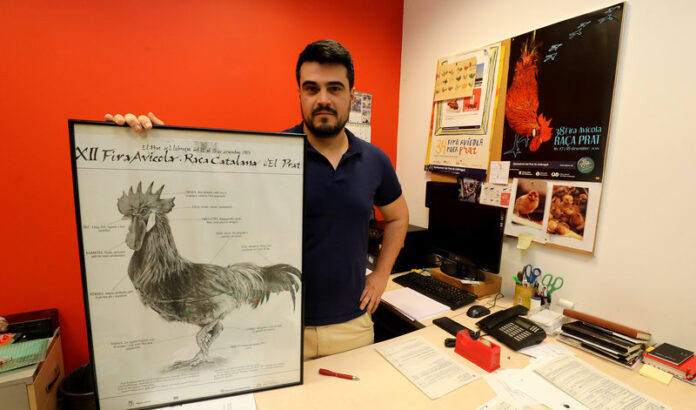
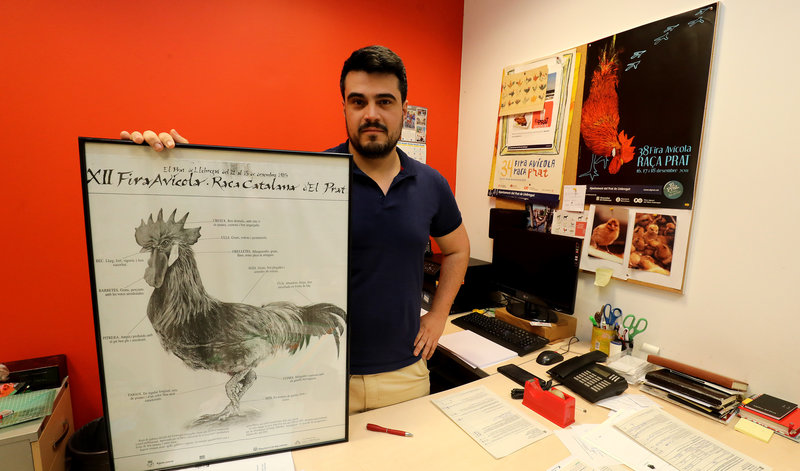
The “pota blava” (blue leg) is something more than a chicken for the people of El Prat. It is an emblem, an element of identity, to the point that some people have it as a tattoo and others display a sticker on their car. Gerard Llamas is a teacher of Catalan, Spanish, history, and Latin at a private academy and had never had any connection with chicken farming.
He explains that, as a native of El Prat, he grew up with the identity of being a “blue leg”, attending the poultry fair organised by the council and the breeders for more than half a century. But it was through getting to know this chicken more closely and coming into contact with the former president of the Breeders’ Association that he fell in love with this bird.
The Breeders’ Association raises cockerels and hens to maintain the breed and organises the poultry exhibition within the fair.
In 1975, breeder Rosa Álvarez organised the first show in which farmers displayed their cockerels and held a competition among themselves. In 1985 Álvarez herself, together with other farmers, founded the Associació de Criadors de la Raça Prat, in order to protect this free-range bird, promote its consumption, and also to improve it and ensure its survival. Valentina Guisado took over the presidency in the 1990s, and at the end of 2025 Llamas succeeded her.
Source:
-. Rosa M. Bravo. Diari El Punt, 13 April 2026.
For further information:
-. The Feria de la Raça Prat