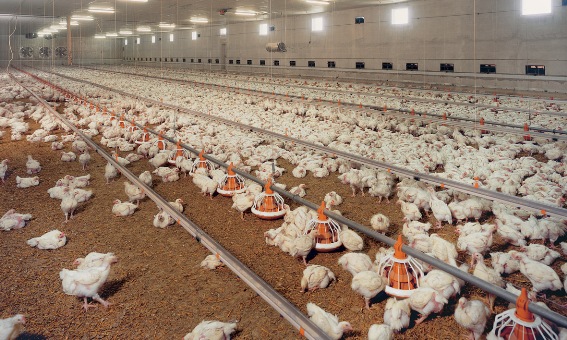

1-. The crossroads: European food sovereignty under siege
Arenys de Mar, 28 February 2026. – Safeguard. From the Latin salvus (safe, secure) and the Germanic wardōn (to watch, to protect). A guardian set in place to protect a valued asset. So it has been defined in the Dictionary of the Spanish Language since 1925: custody, protection, guarantee. The word promises security. The problem arises when the guardian arrives too late, looks the other way, has its hands tied — or when the gate itself (la puerta) has been designed with more holes than a Gruyère cheese.
That is precisely what is happening with the tariff safeguard clauses in the EU-Mercosur agreement: they bear a reassuring name, but their design raises more questions than it answers. Can they genuinely halt an import surge when they are triggered only after the damage has already been done? Do they protect European poultry farmers competing at production costs 2.6 times higher than those in Brazil, or do they merely serve as window dressing for an agreement that needed to be sold as balanced?
What follows is an unflinching analysis of why these safeguards, as currently conceived, risk guarding and saving nothing whatsoever.
2-. European poultry farming is not against free trade — it is against competing under different rules.
The European broiler sector is currently going through one of the most critical and defining periods in its contemporary economic and regulatory history. The convergence of trade liberalisation policies, unprecedented domestic environmental requirements, and global health crises has placed the poultry meat industry at the epicentre of an existential debate about the future of food sovereignty on the continent.
At the heart of this perfect storm lies the imminent resolution of the Association Agreement between the European Union (EU) and the countries forming the Mercosur bloc, a free trade agreement which, after more than two decades of arduous and opaque negotiations, threatens to irreversibly reshape the operational viability of poultry integrators, the current European poultry meat production system, and the vital rural socioeconomic fabric that the old continent needs if it is to genuinely secure its food sovereignty.
The controversy reached an unprecedented boiling point at the start of 2026. The Association of Poultry Processors and Poultry Trade in the EU (AVEC), representing the vast majority of poultry meat producing companies on the continent, expressed outright and categorical opposition following the January 2026 green light for the approval of the EU-Mercosur agreement within the European Council.
This resounding sectoral rejection has been joined by an unprecedented cross-cutting coalition comprising grassroots farming organisations, trade union platforms defending livestock farmers’ rights, interprofessional bodies, and prominent environmental organisations, all of which have unanimously denounced the agreement as a systemic betrayal of farmers, European consumers, and the global ecosystem itself. Against this backdrop of extreme social anger, the livestock sector has placed all its institutional hopes in the Union’s representative chamber (see the article The European Parliament: the last hope for blocking an ‘unjust’ deal with Mercosur), which underscores Parliament’s role as the final democratic bulwark.
Mercosur is not the only door the EU is flinging wide open.
However, the threat to the balance of the internal market does not stem exclusively from the Southern Hemisphere. Simultaneously and in parallel with the South American crisis, EU trade policy is facing a severe fracture on its Asian flank. A recent and comprehensive audit carried out by the European Commission’s Directorate-General for Health and Food Safety (DG SANTE) in the People’s Republic of China, which was quietly published on 12 February 2026, has uncovered alarming systemic deficiencies in traceability protocols and animal welfare standards, prompting an immediate call from the European sector for the precautionary suspension of poultry imports from that country.
3-. Double standards: Brussels’ regulatory hypocrisy
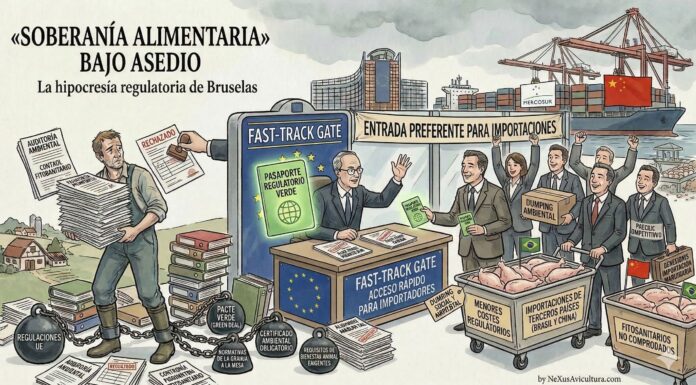
On the one hand, European institutions impose on their poultry farmers and integrators the most draconian and rigorous standards in the world under the framework of the European Green Deal and the “Farm to Fork” strategy; on the other, they facilitate and promote the mass entry of non-EU products that compete unfairly by not being subject to the same financial and operational burdens.
4. “Provisional application”: the shortcut to bypass democracy
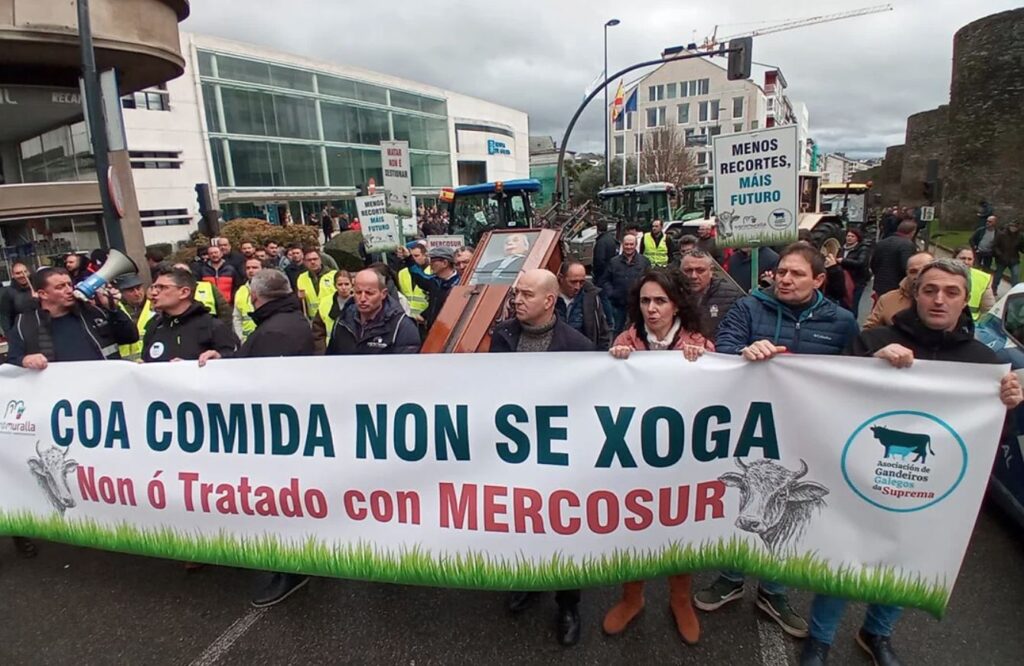
One of the most contentious, divisive, and legally complex aspects of the current geopolitical landscape is the controversial institutional manoeuvre driven by certain factions within the Commission and the Council to implement the EU-Mercosur Agreement immediately through the mechanism cynically dubbed “provisional application”.
4.1 -. An agreement designed to enter through the back door
On 17 January 2026, representatives of the European Union and the South American bloc signed an ambitious trade and cooperation package structured around two distinct legal instruments: a comprehensive Association Agreement (EMPA) and an Interim Trade Agreement (iTA). This latter instrument, the iTA, was specifically and surgically designed to be applied immediately upon signature.
| The EU-Mercosur Interim Trade Agreement (iTA), part of a broader association agreement (trade, political dialogue, cooperation), was signed in early 2026 to rapidly implement economic benefits and eliminate tariffs, following more than 25 years of negotiations. This treaty creates one of the world’s largest free trade zones (700–800 million people), benefiting sectors such as machinery, agri-food, automotive, and services. Interim Objective: The iTA seeks provisional application of the trade pillars without requiring ratification by all EU member states, enabling faster entry into force to reduce tariffs on 90–95% of products. Economic Impact: Eliminates €4 billion in export tariffs for the EU. Mercosur (Brazil, Argentina, Paraguay, Uruguay) will obtain improved conditions for its agricultural and raw material exports. Key Sectors — EU to Mercosur: Automotive, chemicals, pharmaceuticals, and machinery. Mercosur to EU: Beef, poultry products, sugar, honey, soya, and wine. Sustainability: The agreement includes commitments to the Paris Agreement, the fight against deforestation, and labour protection. Current Status (28 February 2026): The EU Council gave the green light for signature in January 2026; the agreement now awaits approval by the European Parliament and the national parliaments of the Mercosur countries. Strategic Context: Aims to diversify trading partners vis-à-vis China and the United States, strengthen EU foreign direct investment (FDI) in the region, and counter global instability. The definitive association agreement will cover non-trade matters requiring a longer ratification process, while the iTA acts as an engine for immediate economic opening. |
4.1.1 -. Institutional crisis: Parliament strikes back
nnnnHistorically, and as an unwritten but scrupulously observed custom since the entry into force of the Treaty of Lisbon in 2009, the Council of the European Union has maintained the unwritten yet meticulously respected practice of waiting for the European Parliament to cast its approval vote before proceeding with the provisional application of any major trade agreement.
nnnnnnnnnThe activation of this technical provision has triggered a political and institutional crisis of the first magnitude within the Union.
n
This practice ensured that, before altering tariffs and opening borders to irreversible socioeconomic impacts, the direct representatives of European citizens would validate the relevance of the agreement. However, faced with growing and intense public pressure and the realisation that the agreement lacked the necessary support in the chamber, the European Parliament took an unprecedented decision: to postpone its ratification vote and, in an exercise of preventive oversight, refer the full text of the agreements to the Court of Justice of the European Union (CJEU) to request an advisory opinion on its compatibility with the founding treaties.
This referral to the CJEU has halted any possible binding parliamentary vote for an estimated period of at least one year, placing the European Commission and the Council before a constitutional dilemma of extreme gravity with two options:
Option A) proceed with the provisional application of the trade pillar (the iTA) deliberately disregarding the chamber’s request for a pause, or
Option B) completely halt the entry into force of the agreement until the Luxembourg judges deliver their ruling.
The splitting of the original treaty into two blocs —separating the pure trade agreement from the political agreement in order to circumvent the need for unanimous ratification by the national parliaments of all 27 Member States— is perceived by broad sectors as a tactic designed to evade public scrutiny, a dynamic that we at NeXusAvicultura believe it is important to denounce.
4.2 -. Cross-cutting rejection: nobody accepts bypassing the chamber
nnnnThe reaction to the possibility of the Council proceeding with provisional application while bypassing Parliament has been one of absolute and categorical condemnation from multiple civil society and industrial stakeholders. AVEC, representing the poultry sector, has declared that any attempt to provisionally apply the agreement before a parliamentary vote would constitute an exceptionally serious violation of the most elementary democratic principles of the Union, warning that European trade policy loses all its legitimacy and credibility if it is carried out with its back turned to citizens and the affected productive sectors.
nnnnThis indignation is not limited to the meat sector. Organisations such as the European Coordination Via Campesina (ECVC) have issued strongly worded statements in which they vehemently condemn the attitude of the European Commission, accusing it of placing abstract geopolitical interests and the agendas of major European export industries above the survival of European farmers, rural communities, and the very democratic foundations of the continent.
nnnnThe systematic exclusion of dissenting voices was made apparent in the consultation process. As we documented extensively in the article “EU-Mercosur Agreement: What the EU has not asked the poultry and livestock sector“, in the prior public hearings organised by the European Parliament’s International Trade Committee (INTA), the livestock and poultry sectors most vulnerable to the agreement were deliberately excluded from the debate panel.
nnnnThis selective configuration of the hearings, aimed at projecting a partial and misleading image of the treaty’s benefits while silencing warnings about its existential threat, has further eroded the primary sector’s trust in the negotiating institutions.
nnnnnnn
5 -. The numbers don’t lie: let’s not be taken for a ride
nnnnThe visceral, well-founded and unanimous rejection of the European poultry meat industry towards the EU-Mercosur Agreement is not based merely on procedural or institutional objections, but on a rigorous analysis of the direct and devastating economic impact that the new market access conditions will have on the poultry meat value chain produced in Europe.
nnnn5.1 -. The breast: a direct target: 90,000 tonnes against the margin that sustains the chain
nnnnThe final text of the agreement stipulates the granting of tariff-free import quotas for a massive volume of 180,000 tonnes per year of poultry meat from Mercosur countries (mainly Brazil and Argentina), which will be divided equally between 90,000 tonnes of bone-in meat and 90,000 tonnes of boneless meat.
nnnnnnnnnThe substantial increase in chicken breast imports would directly hit the sector as it is the portion of the broiler with the highest commercial margin.
n
To properly gauge the magnitude of this figure and its disruptive potential, it is essential to analyse the volume in relation to the pre-existing balance of the internal market.
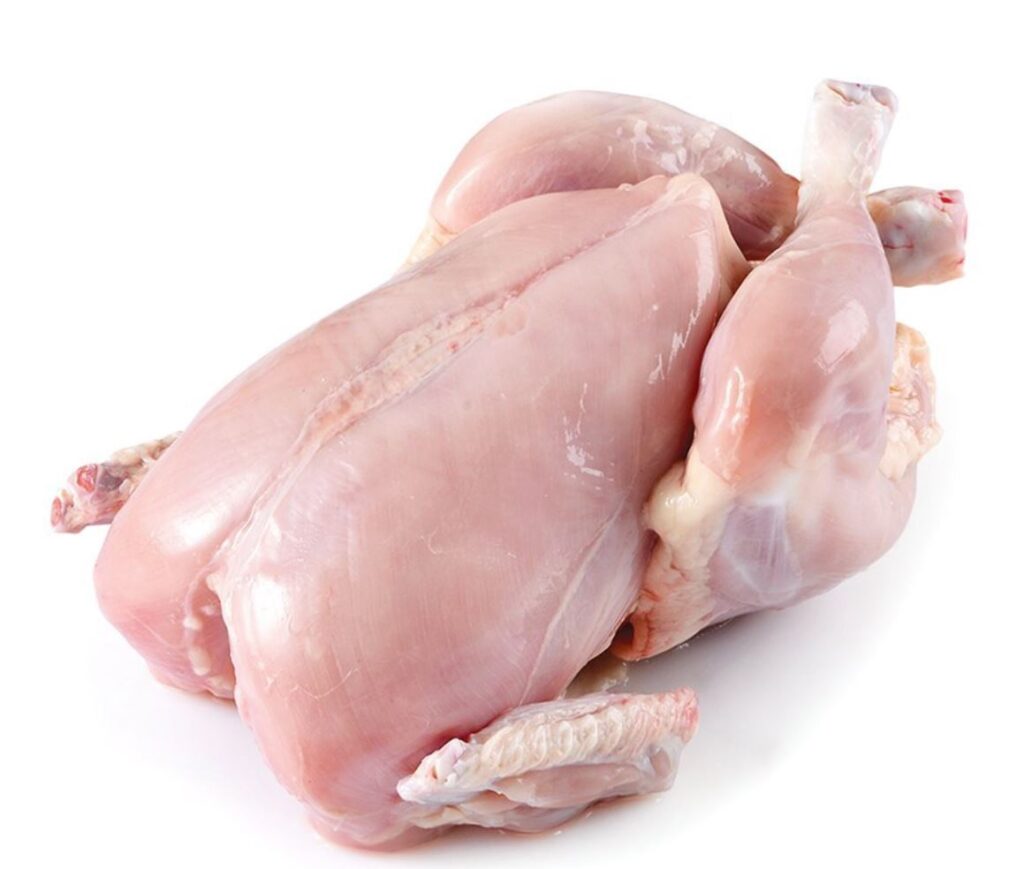
Were it to materialise in its entirety, this new wave of imports would raise total foreign entries to the equivalent of 9% of total poultry meat consumption across the entire European Union. At present, the European market is already under extreme import pressure: more than 25% of the chicken breast meat consumed in the EU originates from third countries.
nnn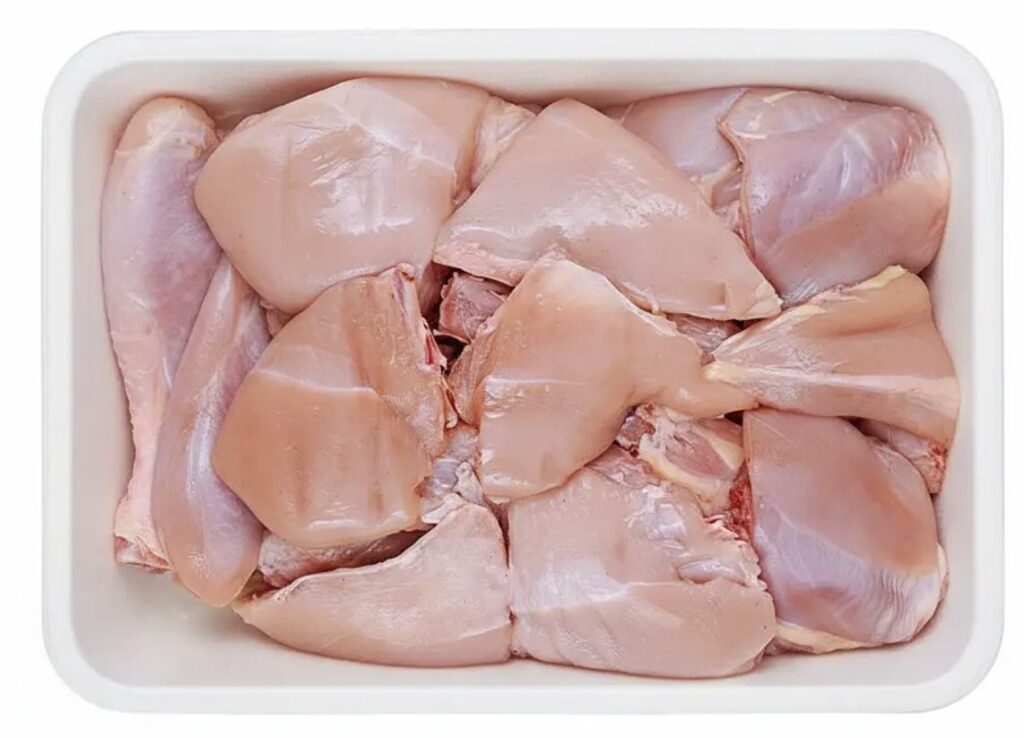
It is essential to look closely at the details of European poultry production to assess this figure: the sector operates on extremely tight profit margins from the sale of whole carcasses or lesser cuts (such as thighs or wings). The profitability of the entire production chain, from the hatchery to the processing plant, is sustained almost exclusively by the commercial margin generated by the breast (the highest value-added boneless cut). The direct injection of an additional 90,000 tonnes of boneless meat into the market, originating from Brazil —a country that enjoys insurmountable competitive advantages in terms of feed costs, land, labour, and energy— will act as a deflationary hammer on European internal prices (and so the short-sighted politician adds a medal for lowering the cost of the shopping basket, even if it is, and this will never be acknowledged, at the expense of reducing food safety, making generational renewal less attractive, and jeopardising food sovereignty). Let us remember that in politics, what matters is not what is done, but what appears to be done.
This asymmetric pressure is not new. The European poultry industry is already grappling with and suffering the cumulative consequences of other free trade agreements and unilateral emergency concessions, such as the quota-free tariff exemptions granted to Ukraine to support its wartime economy.
nnnn
5.2 -. The safeguard that will never trigger: autopsy of a mathematical fallacy
nnnnTo mitigate the political resistance of agricultural sectors and attempt to placate Member States with strong livestock interests (such as France, Austria, Poland, Hungary, Ireland, and Italy — let us recall that the Spanish Government voted in favour of the Mercosur Agreement), the European Commission has constructed a narrative based on the supposed protection offered by the inclusion of a “safeguard clause”. According to the official narrative, this legal mechanism would be designed to trigger automatically and halt sudden increases in imports that could cause serious disruptions to the internal market.
nnnnnHowever, if we dig a little deeper and carry out an in-depth technical scrutiny (not the “smoke and mirrors” press releases from the EC) of the wording of said clause, it reveals that this is a completely inoperative, ineffective instrument conceived as a political “optical illusion”. For the European broiler sector, the safeguard is nothing more than a strategic communication tool used by the Commission to sell us the deal as balanced, knowing full well in advance that it can never be activated to protect European poultry farmers and livestock producers.
nnnn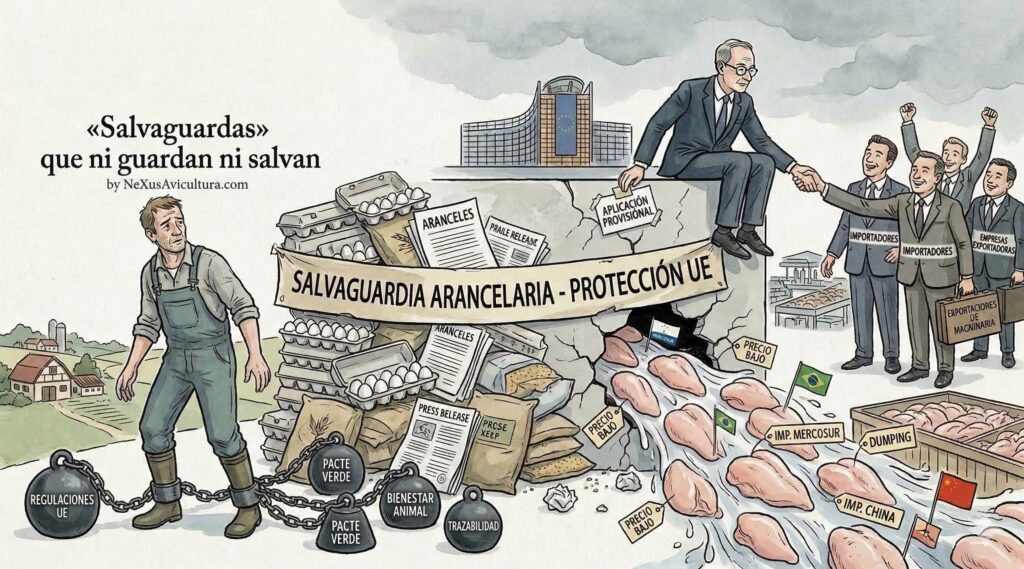
For the safeguard clause to enter into force and deploy its protective measures, the legal text requires that two conditions be met rigorously and simultaneously :
nnnn- n
- Preferential Volume Growth: Imports of poultry meat from Mercosur countries must experience an increase of more than 10% year-on-year under preferential tariff conditions. nnnn
- Price Suppression at Destination: The prices of imported products must be at least 10% below the average prices prevailing in the EU’s internal market. n
The material and empirical impossibility of activating this mechanism lies in the mathematical architecture underlying the first condition, closely linked to the progressive implementation schedule (“phase-in”) of the new quotas. The agreement stipulates that the additional quota of 180,000 tonnes will not flood the market at the moment of signing, but will instead be introduced gradually over a transitional period of five years, through annual increments of 30,000 tonnes.
nnnnnnnnThe deliberate structural flaw, exposed by AVEC’s economists, lies in the base volume upon which that 10% percentage increase is calculated. In the reference year 2024, long before the agreement entered into force, the European Union was already a massive net importer from the region, purchasing the exorbitant quantity of 286,600 tonnes of poultry meat from Brazil alone.
nnnnThe following provides an analytical breakdown of why the safeguard is a mathematical artifice:
nnnn| Phase-in Period | Stipulated Annual Increment | Total Accumulated Agreement Quota | Historical Base Volume (Ref. Brazil 2024) | Approximate Percentage Increase over Previous Volume |
| Year 0 (Start) | + 30,000 Tonnes | 30,000 Tonnes | 286,600 Tonnes | ~10.4% (Only theoretical moment of near risk) |
| Year 1 | + 30,000 Tonnes | 60,000 Tonnes | 316,600 Tonnes (Expanded base) | ~9.4% (Does not meet the condition) |
| Year 2 | + 30,000 Tonnes | 90,000 Tonnes | 346,600 Tonnes (Expanded base) | ~8.6% (Does not meet the condition) |
| Year 3 | + 30,000 Tonnes | 120,000 Tonnes | 376,600 Tonnes (Expanded base) | ~7.9% (Does not meet the condition) |
| Year 4 | + 30,000 Tonnes | 150,000 Tonnes | 406,600 Tonnes (Expanded base) | ~7.3% (Does not meet the condition) |
| Year 5 | + 30,000 Tonnes | 180,000 Tonnes | 436,600 Tonnes (Expanded base) | ~6.8% (Does not meet the condition) |
As the technical projection demonstrates, given that the calculation of the 10% year-on-year increase is applied to a total historical volume that is already hypertrophic, the mere addition of 30,000 tonnes per year will never reach the threshold required to trigger the alert from the first consolidated year onwards.
nnnnnnnnnnnnnThe so-called “safeguard” that is supposed to protect the poultry sector is an insult to one’s intelligence.
n
It has been artificially designed so that it can never be applied.
As the denominator (the total base volume of imports) grows year after year, the relative percentage of the fixed 30,000-tonne increment progressively decreases, neutralising the safeguard’s protective mechanism from the outset.
Therefore, AVEC is right to describe the first condition as “essentially impossible to fulfil” in the economic practice of the sector, leaving European poultry farmers in a state of absolute defencelessness against structural market shifts.
This genuine mockery was already exposed by a series of livestock and agricultural organisations that have repeatedly denounced the fact that the activation thresholds are designed in such an artificially unattainable manner that the clause represents an institutional deception, ineffective in correcting the asymmetric imbalances of international trade in proteins.
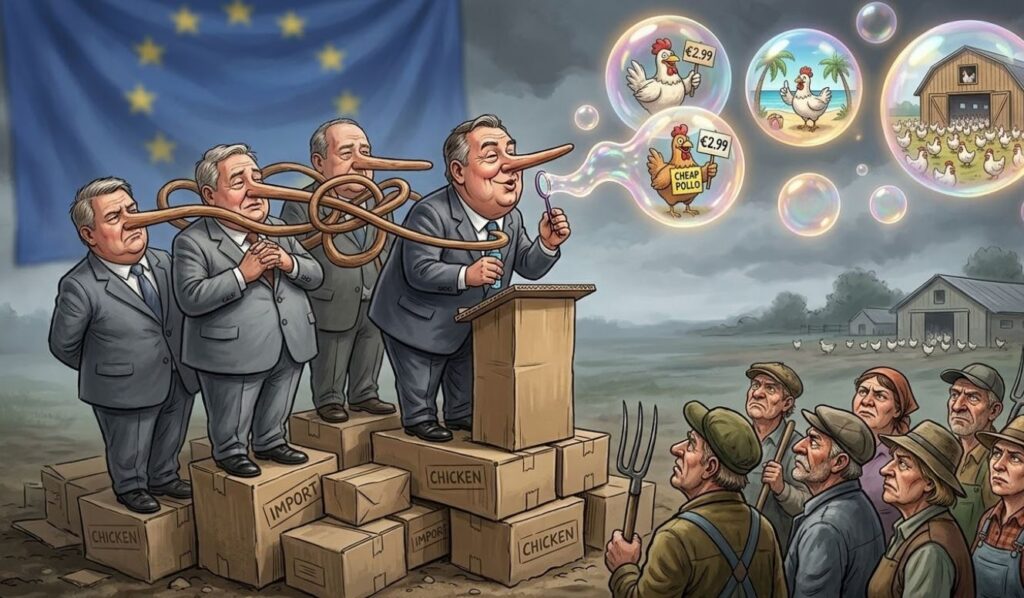
6. The regulatory abyss: competing with one’s hands tied
nnnnThe central and morally most compelling argument underlying the European agri-food sector’s opposition to the EU-MERCOSUR agreement lies in the flagrant lack of regulatory reciprocity imposed by the Brussels authorities.
EU poultry farmers and livestock producers carry out their activities under the most demanding, restrictive, and costly regulatory framework on the planet in matters relating to food safety, animal welfare, ecosystem protection, emissions reduction (aligned with the Green Deal), and the safeguarding of workers’ social rights. Forcing this production model to compete without protective tariffs against systems that do not come close to having such a strict regulatory framework is tantamount to institutionalising international dumping.
6.1 -. Environmental dumping: prohibited here, permitted there.
nnnnDozens of agricultural, environmental, and trade union organisations, from grassroots livestock farmers to meat industry employer associations, have denounced and brought to the attention of the European Commission the fact that the large agroindustrial complexes of Mercosur operate within a framework of absolute comparative deregulation with respect to the strict requirements imposed on EU farmers. This regulatory gap manifests itself in a critical and scandalous manner in the management of plant protection products and agrochemicals, fundamental factors in determining the final cost of animal feed.
nnnnThe scientifically supported data are devastating: Brazil, the bloc’s leading exporting giant, currently permits the use of more than 30 active chemical substances for the commercial cultivation of sugarcane (vital for ethanol and by-products) that are strictly prohibited in the territory of the European Union due to their proven high toxicity or potential endocrine-disrupting effects. Even more alarming for the poultry sector is the situation regarding cereal crops: 52% of the pesticide and herbicide substances commercially authorised for maize cultivation in Mercosur countries are not permitted under any circumstances in the EU. Given that maize and soya account for up to 70% of the total production cost of a broiler chicken, this regulatory disparity, among many others, confers on South American integrators a massive and unattainable competitive advantage. The European poultry farmer loses competitiveness not through technical inefficiency, but by legal mandate from their own government — a government that simultaneously opens the door to meat produced using practices it has banned domestically.
nnnn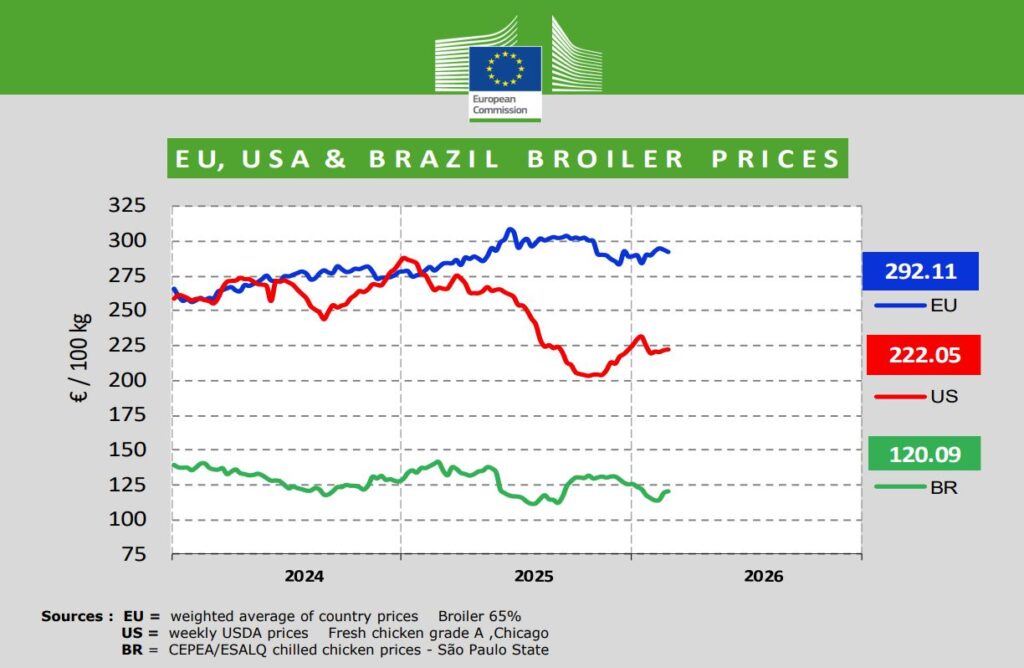
Regarding biodiversity, the treaty’s forest protection stipulations lack binding enforcement mechanisms, leaving thousands of hectares exposed to deforestation in order to expand soya monocultures. The so-called climate “rebalancing mechanism” has been interpreted as a rhetorical concession that undermines the global credibility of the Green Deal.
nnnn6.2 – Labour costs and protection worlds apart, and the destruction of the rural fabric
nnnnThe asymmetry extends beyond agronomy into the realm of labour rights. The nations forming the core exporting bloc of Mercosur have labour protection legal frameworks that are substantially weaker and more lax than the EU’s social acquis.
nnnnThe threat is compounded by the discouragement of generational renewal and the condemnation of European livestock farming to a slow extinction. Currently, barely 6.5% of EU farmers and livestock producers are under 35 years of age, and only 11.9% are below 40. The prospect of competing in a market permanently depressed by imports based on social dumping discourages any bank investment or entrepreneurship by young producers, condemning European livestock farming to a slow but inexorable extinction.
nnnn6.3. Ghost traceability: the mirage of imported food safety
nnnnFor the contemporary European consumer, food safety and animal welfare are not added values, but non-negotiable prerequisites.
However, DG SANTE audits have revealed systemic deficiencies in the health controls of Mercosur exporters. While Europe demands preventive hygiene “from farm to fork”, the Mercosur industry relies on post-mortem corrective methods banned in the EU, such as carcass washing with chlorinated solutions. Added to this is an almost total absence of reliable traceability, making it impossible to verify whether the meat comes from recently deforested areas or to certify the absence of drug residues.
To make matters worse, the European consumer is defenceless against this flood of imported products due to significant gaps in EU labelling legislation, which does not mandatory require the specification of the country of origin of poultry meat when it is used as an ingredient in ultra-processed products or served in the vast hospitality and foodservice channel (HORECA). As a direct result, millions of citizens will daily consume Mercosur chicken without their knowledge, erroneously assuming that the food they eat meets the strict European standards of animal welfare and food safety, which will ultimately fracture public trust in the entire regulatory system of the Union once the deception becomes evident.
nnnnnnnnn“millions of citizens will daily consume Mercosur chicken without their knowledge“
n
6.4. Not just Mercosur: the Asian front that nobody is watching
nnnnBetween January and October 2025, imports of poultry meat and by-products from China to the EU grew by 33.6%, reaching some 50,000 tonnes and making China the fifth largest external supplier of poultry meat to the EU.
A DG SANTE audit conducted in November 2025 and published on 12 February 2026 revealed serious systemic vulnerabilities in Chinese exporting plants: critical deficiencies in traceability, widespread failures in animal welfare during stunning and bleeding at slaughter, lack of knowledge among Chinese certifying veterinarians of EU regulations, and an almost total absence of functional communication between the various Chinese administrations involved in health certification.
These findings call into question the reliability of the official certification accompanying containers exported to Europe. An issue that goes far beyond the debate on MERCOSUR and that deserves the sector’s full attention.
6.5 -. The shadow of «Carne Fraca»: when certifications are worthless
nnnnGiven the scale and severity of these official findings, which threaten to destabilise confidence in the entire EU import system, the European Commissioner for Health and Food Safety, Olivér Várhelyi, was compelled to issue a robust response.
The Commission forwarded to the Beijing authorities a detailed list of mandatory and non-negotiable corrective actions, setting a firm deadline inexorably fixed for 28 February 2026. Brussels’ set of conditions demands that the Chinese government provide absolute documentary and operational guarantees that all fresh meat and meat products exported derive exclusively from animals that have been processed in compliance with the welfare standards stipulated by EU law, and that intensive training programmes be urgently implemented to ensure that certifying officials are familiar with and can truthfully attest to the legality of such requirements before sealing the exports.
The Union’s institutional position was reinforced by statements from Commission spokespersons, who underlined as official doctrine that “all food products entering the EU, without exception, must scrupulously comply with the same high health and food safety standards that are mandatory for those produced on EU territory, in order to comprehensively protect the health and integrity of our citizens“.
nnnnFrom the strategic perspective of the European poultry sector, passivity in the face of the results of the China audit is intolerable. Industry leaders have drawn a direct and highly pointed argumentative parallel between the current situation in Asia and the enormous international food fraud scandals of the recent past (2016-2017), making express and prominent mention of the infamous operation Carne Fraca uncovered in Brazil.
In that scandal, a mafia network of institutional corruption was uncovered involving state inspectors and senior corporate executives, who operated a systematic scheme of document forgery and falsification of health certificates, fraudulently exporting to the EU and other destinations thousands of tonnes of meat in deficient condition or in a state of putrefaction concealed with chemicals.
AVEC firmly argues that keeping trade channels open in the face of irrefutable evidence, officially documented, that certifications issued by a third country lack administrative reliability, constitutes a negligent and direct assault on the fundamental tenets of EU public health. Furthermore, this institutional inaction creates a profound distortion of free competition in the internal market and threatens to destroy consumer confidence in the European logo and in the presumption of regulatory uniformity of meat products displayed on the shelves of continental supermarkets.
nnnnThe EU’s regulatory credibility cannot afford geopolitical cracks when it comes to food chain safety, demanding the unrestricted application of the precautionary principle with regard to China as a message of firmness that can be extrapolated to the imminent commercial tsunami of Mercosur.
nnnnnnnn7-. Corporate survival: European integrators seek oxygen abroad
nnnnFaced with this uncontrolled opening to poultry meat from third countries, what options are left for the major European poultry integrators?
nnnnThe suffocating convergence of an open-door trade policy with an ever-tightening internal regulatory framework is forcing a metamorphosis in the corporate strategies of the continent’s major poultry and livestock operators. Given the realisation that European institutions, paralysed by diplomatic agendas, appear willing to sacrifice local primary production in exchange for facilitating the export of industrial manufactures and services, integrator companies are accelerating corporate survival strategies that paradoxically further weaken the food sovereignty of the old continent.
nnnnThe predominant response has been risk hedging through internationalisation and capital investment in the competing countries themselves. A paradigmatic example of this practical approach to the EU’s inconsistencies is laid out with crystalline clarity in the interview “We keep our ears permanently open”. This minority associative investment model does not seek to dismantle the national productive base in the short term, but rather to establish a systemic risk diversification network.
European corporations contribute their invaluable technological know-how, health protocols and logistical efficiency, while leveraging the in-depth local market knowledge of their South American partners and, fundamentally, benefiting from unlimited access to raw materials (grains) and production systems far more cost-effective than in Europe.
A painful paradox thus becomes entrenched: European agro-industrial capital finances the technification of Latin American livestock farming, increasing its efficiency and export capacity towards Europe, while local family farms that lack the financial muscle to internationalise bear the full impact of price cuts in the domestic market.
The poultry sector is intrinsically a resilient, circular model that boasts the most efficient feed conversion ratio among terrestrial livestock species, resulting in the lowest carbon footprint per kilogram of meat protein produced. However, without the materialisation of the demands required to ensure medium-term survival —urgent simplification of the stifling regulations that operationally paralyse farms, absolute and non-negotiable guarantees of border protection against unfair competition, and decisive public financing plans to stimulate technological modernisation and encourage the entry of young poultry farmers and livestock producers— the industry warns that Europe is irrevocably hurtling towards a very serious outsourcing of its food security and sovereignty.
8-. One single word: coherence
nnnnThe European poultry sector’s request to the EU could not be clearer: coherence in trade policy, in food safety and in animal welfare.
nnnnThe synthesis of the multiple open fronts reveals a flagrant and unsustainable incoherence at the heart of EU policies. EU institutions demand the implementation, at the cost of colossal investments, of ambitious internal regulatory objectives grounded in the hyper-regulation of environmental sustainability, the welfare of farmed animals and preventive health. Yet these same institutions undermine these pillars by endorsing open-door trade agreements, conceived from a purely macro-industrial and geopolitical perspective, where EU agriculture is treated as an acceptable collateral damage and a mere bargaining chip in international negotiations.
nnnn
In this regard, the deep controversy surrounding the mechanism they have pulled out of their sleeve of “provisional application of the EU-Mercosur Agreement” crystallises an institutional conflict of extreme gravity that affects the European democratic deficit. The official referral of the agreement text to the legal scrutiny of the Court of Justice of the European Union highlights the unbreakable need to ensure that no commercial ambition of the Commission de facto subverts the complex and delicate balance of powers and constitutional competences established within the Union.
nnnnOn the purely economic front, the duty-free tariff quotas agreed in favour of the South American bloc —which will flood the continental market with an additional 180,000 tonnes per year of poultry meat, in a strategic segment such as breast meat where foreign import penetration already alarmingly exceeds the 25% threshold— represent a missile fired directly at the waterline of EU producer profitability. Rigorous mathematical projections on the technical design of the safeguard clause —an instrument that is functionally and statistically neutralised by the prolonged dilution effect caused by its gradual implementation over a five-year period, calculated against a substantial historical import base that already reached 286,600 net tonnes originating from Brazil in 2024— make it unequivocally clear that the protective measures negotiated and presented to the public are illusory in nature and lack any practical and real functional operability.
nnnnnnnnThe regulatory asymmetry constitutes, without a shadow of a doubt, the main structural threat against the progress and future of the EU poultry sector:
imposing on local poultry farmers the titanic task of competing head-on and in a fully open market against non-EU poultry production that operates under legislative frameworks on labour, environmental and animal welfare rights that are comparatively negligible.
This picture of deterioration is further darkened by the continuous findings of systemic deficiencies and deep structural failures in the complex inspection networks and sanitary certification systems of third countries. The evidence encompasses both Brazil —singled out for its persistent technical inability or unwillingness to guarantee transparent traceability and for its questionable practices in the notification of global epidemiological hazards— and, more recently, China.
nnnnnnnnIn short, the evidence and arguments gathered in the current geopolitical and food crisis compel the conclusion that the implementation or entry into force cannot be permitted —whether through provisional application ploys or definitive validations of dubious democratic legitimacy— of any large-scale trade agreement that so glaringly lacks clauses enshrining verifiable mathematical mechanisms of full reciprocity in legal, technical and environmental terms.
It is urgent to design and stipulate genuine trade safeguards, and not “fake safeguards”, and to do so before opening the floodgates of imports into Europe even further. These control and blocking mechanisms must be agile and provide effective economic protection against the uncontrolled avalanche of low-cost imported meat, which, in its wake, not only erodes accounting profitability but risks demolishing the invaluable rural architecture that underpins the agri-food socioeconomic fabric of Europe’s rural population.
Protecting the capacities and intrinsic potential of European producers, safeguarding the very high sanitary and ethical expectations of the continental consumer, and unfailingly sustaining the integrity and reliability of the European food sovereignty system in the face of the storms of unbalanced free trade are non-negotiable premises for securing the lasting progress of the old continent.
Yes to free trade, but with the same rules of the game for everyone.
Let us not be deceived.
Federico Castelló
Founder of NeXusAvicultura.com
To find out more:
-. EU Poultry Meat Dashboard (updated 25th feb. 2026)
-. Agreement EU-MERCOSUR
-. EU-MERCOSUR Agreement impact on Poultry. Report by AVEC-COGAG. 20250624
-. The «safeguard clause»: a false protection, pure window dressing
-. AVEC
nnnn
Do you want to stay one step ahead in poultry?
Subscribe for free to our eNewsletter and receive a weekly selection
of the best information to anticipate trends, stay up to date and grow as a poultry industry professional.
NeXusAvicultura: Vision, Insight, Quality and Context.