
The association representing 95% of European poultry meat companies denounces that applying the agreement before the European Parliament vote would render democratic scrutiny meaningless. At the same time, a Commission audit of Brazil reinforces doubts about the sanitary guarantees offered by Mercosur exporting countries
AVEC strongly opposes provisional application of the EU-Mercosur agreement: European poultry sector demands Parliament not be bypassed
The conflict between the European Union and its own agri-food sector over the trade agreement with Mercosur has reached a new flashpoint. On 27 February 2026, AVEC — the Association of Poultry Processors and Poultry Trade in the EU, representing 95% of Community poultry production — published a statement in which it firmly rejects the provisional application of the EU-Mercosur agreement, a possibility announced by European Commission President Ursula von der Leyen that would allow the trade deal to enter into force before the European Parliament has given its consent.
For AVEC, proceeding in this manner would amount to hollowing out the real substance of democratic scrutiny and undermining the institutional balance established under the EU Treaties. In the association’s own words: the European Parliament is not a formality, but the representative body directly elected by European citizens.
A timeline of growing opposition
AVEC’s statement of 27 February did not emerge in isolation. It is the latest step in a chain of increasingly firm positions taken by the European poultry and agri-food sector — positions worth recapping in order to understand the full scale of the disagreement.
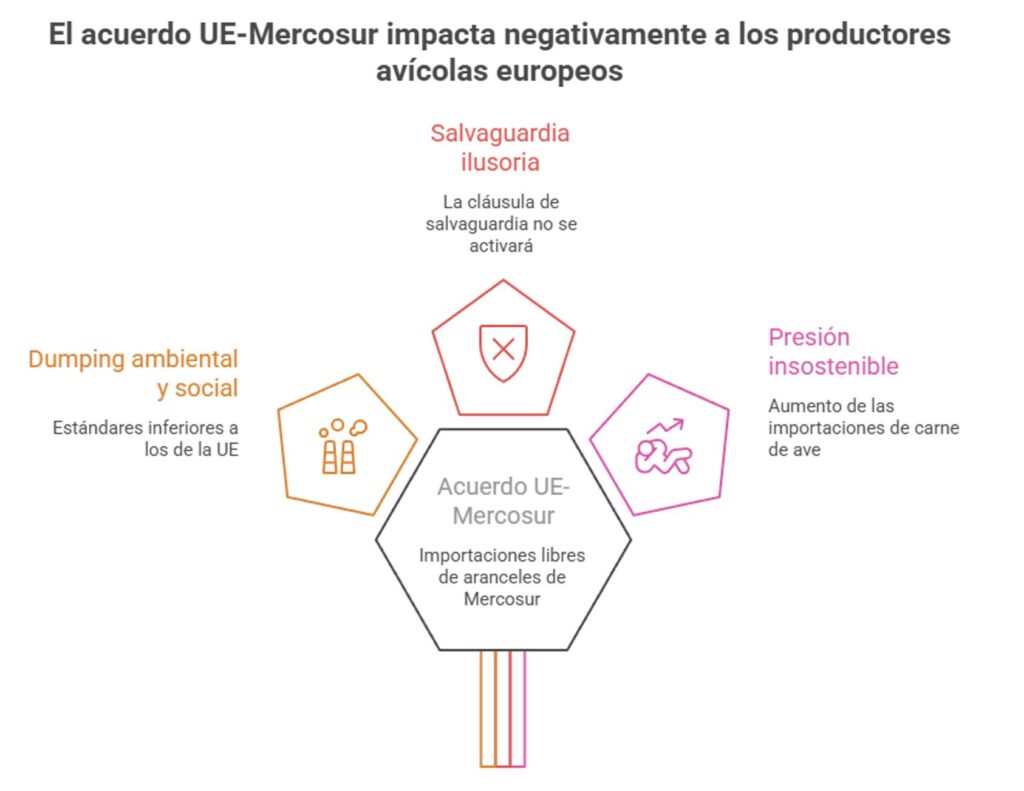
In November 2025, a broad group of European agri-food, trade union, and environmental organisations signed a joint statement describing the EU-Mercosur agreement as a betrayal of farmers, workers, consumers, and the environment. The text denounced that the deal would open the door to tariff-free imports of rice, poultry meat, beef, sugar, maize, and ethanol produced under standards significantly lower than those required within the EU, creating a situation of environmental and social dumping.
Also in October 2025, AVEC had published a damning technical analysis of the safeguard clause included in the agreement, concluding that it is designed in such a way that it will never realistically be triggered for the poultry meat sector. The clause requires that preferential Mercosur imports grow by more than 10% year-on-year and that import prices be at least 10% below Community market prices. Given the pace at which the planned tariff rate quotas (TRQs) are to be introduced — 180,000 additional tonnes to be distributed over five years — the first condition is practically impossible to meet. In practice, the safeguard is illusory.
In January 2026, following the agreement’s approval by the EU Council, AVEC publicly deplored the decision and called on the European Parliament to reject the deal. The association noted that more than 25% of poultry breast meat consumed in the EU already originates from third countries, and that the quotas provided for in the Mercosur agreement (180,000 tonnes) would raise total imports to 9% of Community poultry meat consumption, placing an unsustainable burden on European producers.
The European Parliament itself has requested an opinion from the Court of Justice to determine whether the immediate activation — under the euphemism of “provisional application” — of the EU-Mercosur Agreement is lawful
One of the most significant points in AVEC’s latest statement is the explicit reference to the fact that the European Parliament has formally decided to request an opinion from the EU Court of Justice on the agreement’s compatibility with the Treaties.
“The European Parliament is not a formality. Provisionally applying the EU-Mercosur agreement before it has been voted on is, in spirit, a denial of democratic accountability.”
In this context, the association considers that moving forward with any form of implementation — and especially provisional application — would be politically and institutionally indefensible. If the EU’s highest judicial body is being consulted on the legal foundations of the agreement, the responsible course of action would be to await its ruling before taking any step towards implementation.

The audit of Brazil: when evidence contradicts promises
AVEC also highlights an element that adds a further layer of gravity to the debate: the European Commission audit of Brazil, published on 25 February 2026, just two days before the statement. That audit concludes that, with regard to a critical recommendation aimed at ensuring that products derived from bovine animals treated with oestradiol 17β are not exported to the EU, the action plan submitted by Brazil has not been implemented as committed and the measures adopted have not been fully effective in excluding such meat from the export supply chain.
This finding is not trivial. It reinforces the concerns that the European poultry and livestock sector has been raising for years about the actual reliability of certification and traceability systems in Mercosur countries. Indeed, the joint press release of November 2025 had already warned that previous DG SANTE audits had identified deficiencies in avian influenza surveillance in Brazil, possible under-reporting of outbreaks, and the use of chemical decontamination methods banned in the EU, such as chlorinated chicken.
“The European Commission itself audits Brazil and concludes that its action plan has not been implemented as committed. And yet, at the same time, there are proposals to expand market access?”
China also in the spotlight: consistency as a requirement
It is worth noting that the debate on the reliability of imports is not confined to Mercosur. Just three days before the statement on provisional application, on 24 February 2026, AVEC published another robust declaration calling for the precautionary suspension of imports of poultry products from China, following a European Commission audit (CT-2025-0037) that concluded the official controls underpinning Chinese poultry exports do not provide satisfactory guarantees with regard to public health or animal welfare.
The findings set out in the audit published on 12 February 2026 under the title “FINAL REPORT OF AN AUDIT OF CHINA CARRIED OUT FROM 3 TO 14 NOVEMBER 2025 IN ORDER TO EVALUATE THE OFFICIAL CONTROL AND CERTIFICATION SYSTEMS OVER THE PRODUCTION OF POULTRY MEAT PRODUCTS AND RABBIT MEAT AND PRODUCTS DERIVED THEREFROM TO BE EXPORTED TO THE EUROPEAN UNION” revealed a landscape of systemic and structural vulnerabilities that the industry considers wholly unacceptable as a basis for maintaining open trade.
Poultry meat imports from China grew by more than 30% in 2025 compared to 2024, reaching approximately 50,000 tonnes. The audit identified systemic deficiencies in the supervision of animal welfare at slaughter, traceability, hygiene controls, and the reliability of certification. AVEC Secretary General Birthe Steenberg stressed that the credibility of European food policy depends on all products marketed in the single market offering the same level of guarantees, regardless of their origin.
This stance on China takes on additional significance when read alongside the Mercosur debate: the European poultry sector does not discriminate by geography, but demands consistency in the application of European standards to all imports. If the EU raises the bar for its own producers in terms of animal welfare, sustainability, and food safety, imports must meet equivalent guarantees.
What does all this mean for the poultry sector?
There are several readings that any professional connected to the poultry sector should consider.
The first is that the front of opposition to the EU-Mercosur agreement is not weakening, but intensifying. AVEC has steadily escalated the tone and precision of its arguments since October 2025, moving from a technical analysis of safeguard clauses to outright political rejection following the Council’s approval, and now to questioning the democratic legitimacy of provisional application.
The second is that the Commission’s own audits are providing ammunition for the sector. It is not farm organisations that are denouncing deficiencies in Brazil’s or China’s controls: it is the European Commission itself, through its own audit reports, that is finding that certification and control systems do not provide sufficient guarantees. This places the European institutions in an uncomfortable position: it is difficult to defend expanded market access when your own audits suggest that suppliers are not complying.
The third is that the battle now moves to the European Parliament. With the Council having approved the agreement and the Commission proposing provisional application, the European legislative chamber becomes the last institutional body capable of halting or conditioning the deal. The request for an opinion from the Court of Justice adds an element of legal uncertainty that could delay the timetable.
And the fourth — perhaps the most structural — is that the discussion around Mercosur goes beyond the agreement itself. What is at stake is the EU’s model for agri-food trade policy: if Europe is going to demand the world’s highest standards from its own producers in terms of animal welfare, sustainability, and food safety, it needs to ensure that imports compete on equivalent terms. Otherwise, domestic regulation becomes a competitive handicap and trade policy becomes a source of incoherence.
Coverage on NeXusAvicultura
NeXusAvicultura has covered this topic on an ongoing basis. For further context, we recommend consulting our analyses on Mercosur and its real implications for the European poultry meat sector:
-. The European Parliament, last hope for blocking an ‘unjust’ agreement with Mercosur
-. EU-Mercosur: the Council approves safeguard clauses for agricultural products
-. EU-Mercosur Agreement: What the EU has not asked the poultry and livestock sector
Want to stay one step ahead in poultry?
Subscribe free to our eNewsletter and receive a weekly selection
of the best information to anticipate trends, stay up to date, and grow as a poultry industry professional.
NeXusAvicultura: Vision, Insight, Quality and Context.