The Comunitat Valenciana declares a health emergency over Newcastle Disease
The Pleno del Consell of the Comunitat Valenciana on 30 January 2026 formally approved the declaration of emergency to carry out urgent health measures aimed at the prevention and control of Newcastle Disease. This pathology, characterised by being highly contagious, affects both wild and domestic birds and prompted an immediate response following the confirmation of a positive Newcastle case on 29 December in the municipality of Llutxent, and four further secondary outbreaks in nearby farms. The aim of these new measures is to prevent the emergence of additional secondary outbreaks in the Comunitat Valenciana.
Emergency action plan and allocated budget
To address this health threat, the Regional Ministry of Agriculture, Water, Livestock and Fisheries has designed an emergency action plan with a total budget of €637,622. The planned interventions have a maximum implementation period of three months, with the aim of remedying existing damage and preventing the virus from spreading to other holdings.
The immediate measures include the depopulation of the affected farms and the culling of animals in strict compliance with animal welfare regulations. In addition, the culled birds will be destroyed or buried, along with feed and any other materials that may be contaminated. To ensure the effectiveness of the process, geological surveys will be carried out to identify suitable areas for excavating pits in which both animal remains and the materials and protective clothing used during operations will be deposited.
“Mandatory vaccination is a structural prevention measure that reinforces the health security of the sector.”
Enhanced biosecurity, perimeter control and the hiring of specialist cleaning teams
The containment strategy is not limited to confirmed outbreaks. The authorities have established a biosecurity reinforcement protocol within a 10-kilometre radius around the positive holdings. Within this perimeter, specific surveys will be conducted to assess the level of protection at nearby farms, and disinfectant will be applied to facilities, transport vehicles and equipment that may have come into contact with the virus.
These actions seek an “agile, swift and effective” response to safeguard the region’s poultry sector. The intervention also includes the hiring of specialist teams for the collection and management of contaminated animals and materials.
“The regulatory update will make it possible to introduce mandatory vaccination throughout the Comunitat Valenciana.”
Towards mandatory vaccination across the entire region
Beyond the temporary emergency measures, the Consell is committed to a structural solution. The Directorate-General for Agricultural and Livestock Production is processing an amendment to the Annual Zoosanitary Plan of the Comunitat Valenciana, originally approved on 8 January 2026. This regulatory update will enable the introduction of mandatory vaccination against Newcastle Disease throughout the entire territory of the Comunitat Valenciana.
The Regional Minister for Agriculture has stressed that this measure is vital to ensure the stability of an essential economic activity and to protect Valencian poultry farmers. By incorporating mandatory vaccination protocols, the aim is to raise health safety standards and prevent future outbreaks that could jeopardise animal health and the viability of the poultry sector.
“The emergency action plan has a budget of €637,622 and an implementation period of three months.”
Want to stay one step ahead in poultry farming? Subscribe free to our eNewsletter and receive a weekly selection of the best information to anticipate trends, stay up to date and grow as a poultry industry professional. NeXusAvicultura: Vision, Criteria, Quality and Context.
The Comunitat Valenciana declares a health emergency over Newcastle Disease
The Pleno del Consell of the Comunitat Valenciana on 30 January 2026 formally approved the declaration of emergency to carry out urgent health measures aimed at the prevention and control of Newcastle Disease. This pathology, characterised by being highly contagious, affects both wild and domestic birds and prompted an immediate response following the confirmation of a positive Newcastle case on 29 December in the municipality of Llutxent, and four further secondary outbreaks in nearby farms. The aim of these new measures is to prevent the emergence of additional secondary outbreaks in the Comunitat Valenciana.
Emergency action plan and allocated budget
To address this health threat, the Regional Ministry of Agriculture, Water, Livestock and Fisheries has designed an emergency action plan with a total budget of €637,622. The planned interventions have a maximum implementation period of three months, with the aim of remedying existing damage and preventing the virus from spreading to other holdings.
The immediate measures include the depopulation of the affected farms and the culling of animals in strict compliance with animal welfare regulations. In addition, the culled birds will be destroyed or buried, along with feed and any other materials that may be contaminated. To ensure the effectiveness of the process, geological surveys will be carried out to identify suitable areas for excavating pits in which both animal remains and the materials and protective clothing used during operations will be deposited.
“Mandatory vaccination is a structural prevention measure that reinforces the health security of the sector.”
Enhanced biosecurity, perimeter control and the hiring of specialist cleaning teams
The containment strategy is not limited to confirmed outbreaks. The authorities have established a biosecurity reinforcement protocol within a 10-kilometre radius around the positive holdings. Within this perimeter, specific surveys will be conducted to assess the level of protection at nearby farms, and disinfectant will be applied to facilities, transport vehicles and equipment that may have come into contact with the virus.
These actions seek an “agile, swift and effective” response to safeguard the region’s poultry sector. The intervention also includes the hiring of specialist teams for the collection and management of contaminated animals and materials.
“The regulatory update will make it possible to introduce mandatory vaccination throughout the Comunitat Valenciana.”
Towards mandatory vaccination across the entire region
Beyond the temporary emergency measures, the Consell is committed to a structural solution. The Directorate-General for Agricultural and Livestock Production is processing an amendment to the Annual Zoosanitary Plan of the Comunitat Valenciana, originally approved on 8 January 2026. This regulatory update will enable the introduction of mandatory vaccination against Newcastle Disease throughout the entire territory of the Comunitat Valenciana.
The Regional Minister for Agriculture has stressed that this measure is vital to ensure the stability of an essential economic activity and to protect Valencian poultry farmers. By incorporating mandatory vaccination protocols, the aim is to raise health safety standards and prevent future outbreaks that could jeopardise animal health and the viability of the poultry sector.
“The emergency action plan has a budget of €637,622 and an implementation period of three months.”
Want to stay one step ahead in poultry farming? Subscribe free to our eNewsletter and receive a weekly selection of the best information to anticipate trends, stay up to date and grow as a poultry industry professional. NeXusAvicultura: Vision, Criteria, Quality and Context.
National Control Programme for Salmonella in Laying Hens 2025–2027 — 2026 Version
nnnn
Background
Surveillance and control of Salmonella in poultry farming in Spain has been carried out since 1993, in accordance with Directive 92/117/EEC, repealed by European Directive 2003/99/EC on measures for monitoring zoonoses and zoonotic agents in animals and products of animal origin, with a view to preventing outbreaks of food-borne infections and intoxications.
nnn
nn
nnn
During the period from October 2004 to September 2005, a baseline study was conducted on the prevalence of Salmonella in flocks of Gallus gallus laying hens at Community level. The monitoring and data collection in Gallus gallus laying hen flocks was carried out following the Community-level guidelines set out in Commission Decision 2004/665/EC of 22 September 2004. The flock-level prevalence of Enteritidis and Typhimurium serotypes found in these initial studies was 51.5%, and 73.2% when considering Salmonella spp., according to the data obtained from the study.
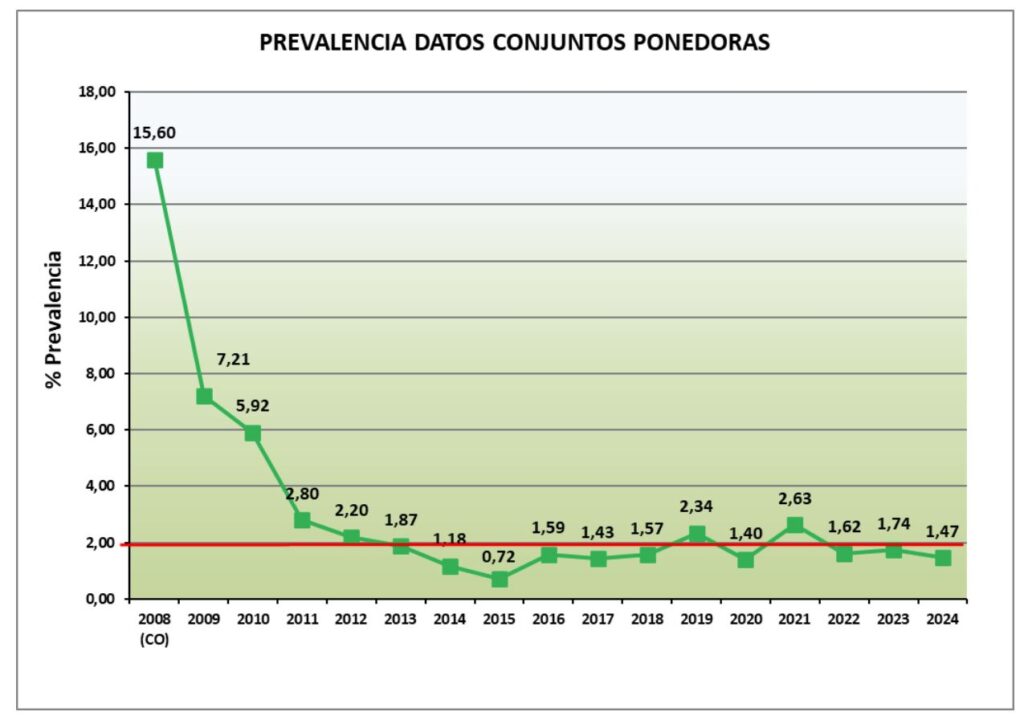
Starting from these high levels, recorded more than 20 years ago, the EU set out to substantially reduce these figures and has since 2006 maintained an annual study, country by country, measuring the prevalence level of Salmonella Enteritidis, S. Typhimurium and S. Typhimurium monophasic variant. The objective was, and remains, annual monitoring and achieving prevalence levels below 2%.
The evolution of prevalence against the Salmonella serotypes subject to control in Gallus gallus laying hen flocks is presented in the graph at the foot of this article, with S. Enteritidis being the most prevalent serotype among those subject to control under the PNCS (National Salmonella Control Plans). In 2024, the prevalence of adult flocks positive for the serotypes subject to control (combined data) was 1.47%, thus remaining within the EU reduction target.
Practical summary of the official programme published by the Spanish Ministry of Agriculture, Fisheries and Food (MAPA).
nnnn
This document provides an operational summary of the obligations, procedures and deadlines that farmers, farm veterinarians, authorised laboratories and official veterinary services need to be aware of in order to comply with the National Salmonella Control Programme (PNCS) for laying hens of the species Gallus gallus.
nnnnnnnn
1. Programme objective
nnnn
n
Target serotypes:Salmonella Enteritidis (SE) and Salmonella Typhimurium (ST), including its monophasic variant.
nnnn
Quantitative target: reduce to 2% or less the maximum percentage of positive flocks in adult laying hens.
nnnn
2024 result: prevalence of 1.47% (within the EU target).
nnnn
Territorial scope: the entire territory of the Kingdom of Spain.
n
nnnnnnnn
2. Who does it apply to?
nnnn
Type of holding
Included in the PNCS?
Notes
Adult laying hens and pullet rearing — eggs for commercial sale
Yes
Full programme of own-checks and official controls
Direct supply of small quantities to the final consumer or local shops
Yes (reduced)
Minimum 1 own-check per year
Egg production for self-consumption (private domestic use)
No
Excluded from the programme
nnnn
Prerequisite: holdings must be authorised and registered by the competent authority.
nnnn
3. Flock identification
nnnn
Each flock is identified with a unique code made up of:
nnnn
REGA + HOUSE (capital letter) + DATE OF BIRD PLACEMENT (mmyyyy)
nnnn
n
The house letter must be displayed on the entry door.
nnnn
The placement date is taken from the flock record or from the holding’s registers.
n
nnnn
n
“If you produce free-range or barn eggs, remember: two pairs of boot covers, 100 steps each. Lazy sampling is costly.”
n
nnnn
4. Definition of a positive flock
nnnn
A flock is considered positive when:
nnnn
n
SE or ST (including monophasic variant) is detected in one or more samples, even if it appears only in the dust sample.
nnnn
Antimicrobials or bacterial growth inhibitors are detected in the flock.
n
nnnn
Counting rule: a positive flock is counted only once throughout its entire production period, regardless of the number of detections or of who collected the sample.
nnnn
5. Own-check schedule (mandatory for the farmer)
nnnn
Phase
Sampling point
Sample type
Day-old chicks
Upon delivery to the holding
Box liners (10 boxes), or viscera from 60 chicks, or meconium from 250 chicks
Pullet rearing
2 weeks before transfer to the laying unit
Fresh faeces (min. 10 points) or 2 pairs of boot swabs (100 steps/pair)
Laying phase
Every 15 weeks, first sampling at 24±2 weeks
According to housing system (see table below)
C&D verification (cleaning and disinfection)
After each depopulation and cleaning/disinfection
Min. 2 swabs of ≥ 900 cm² each
nnnn
Sample type during the laying phase by housing system
nnnn
System
Own-check samples
Cages
2 × 150 g of faeces from belts/scrapers, or from 60 points of the pit if no belts are present. If insufficient material on belts: 4+ moistened swabs of ≥ 900 cm²
Floor / Free-range / Organic
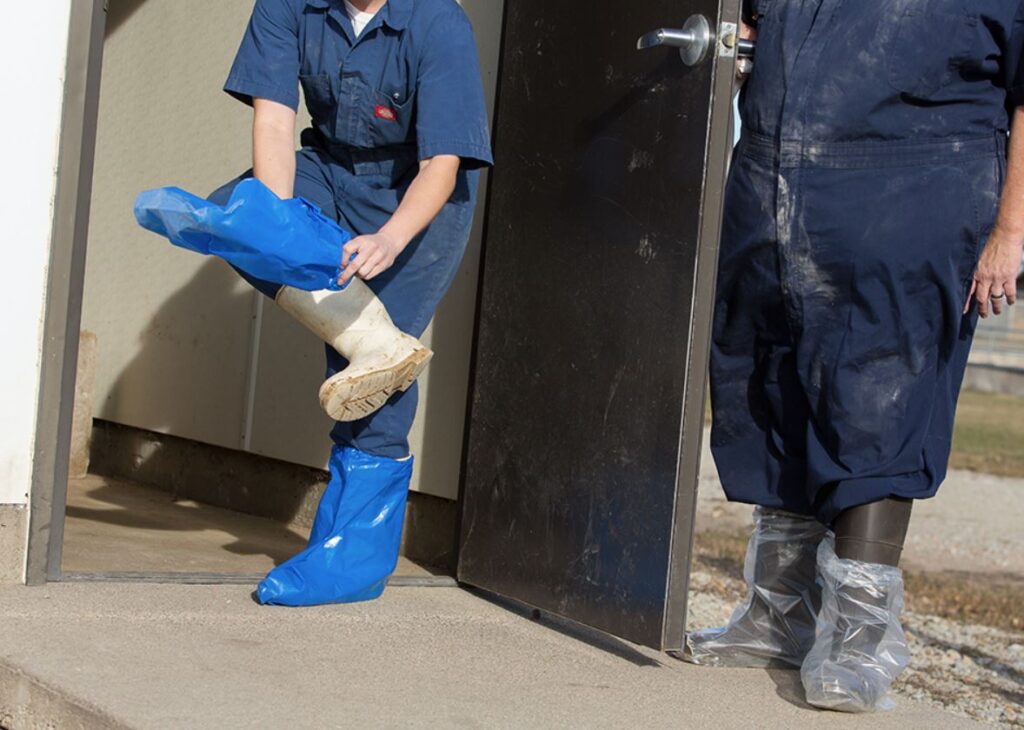
2 pairs of absorbent boot swabs (min. 100 steps/pair), covering all areas of the house
nnnn
Boot swab requirements:
nnnn
n
Pre-moisten with diluent (0.8% NaCl + 0.1% peptone in sterile deionised water, or sterile water).
nnnn
Place over overshoes.
nnnn
Avoid contact with disinfectants in footdips.
nnnn
The 2 pairs may be pooled into a single sample.
n
nnn
nn
nnnnnnn
6. Official controls — What the official veterinarian will do on your farm
nnnn
6.1. Frequency and scope
nnnn
n
Minimum 1 flock per holding per year (in holdings with more than 1,000 birds).
nnnn
Preferably at the end of the production period, within the 9 weeks prior to flock depopulation.
nnnn
An official control replaces the own-check for the same period.
n
nnnn
6.2. Situations triggering an additional mandatory official control
nnnn
n
At 24±2 weeks if the previous flock in that house tested positive.
nnnn
Suspected infection through epidemiological investigation of a foodborne illness outbreak.
nnnn
Detection of a programme serotype in any flock on the holding → control in all other flocks.
nnnn
At any time deemed necessary by the competent authority.
n
nnnn
6.3. Samples in official controls
nnnn
System
Samples
Cages
3 samples (2+1) of faeces from belts/scrapers/pits (150–200 g each)
Floor / Free-range / Organic
3 pairs (2+1) of boot swabs (100 steps/pair). The CA may replace 1 pair with a dust sample (≥ 100 g)
nnnn
A dust sample shall always be taken when:
nnnn
n
Hygiene, health or biosecurity conditions are inadequate.
nnnn
The holding has a history of positive results.
nnnn
Deficiencies have been detected in own-checks or own-checks have not been carried out.
n
nnnn
7. Notification of results — Key deadlines
nnnn
Action
Maximum deadline
Responsible party
Communicate positive result (confirmed or suspected) to the CA
24 hours from becoming known
Laboratory + owner
Send isolate for serotyping to another laboratory
24 hours from isolation
Isolating laboratory
Commence serotyping after receipt of isolate
24 hours
Serotyping laboratory
Issue serotyping report
24 hours from obtaining the result
Serotyping laboratory
Enter own-check results into the MAPA application
1 month from obtaining the result
Authorised laboratory
Send samples to the laboratory
24 hours from collection (otherwise refrigerate)
Person responsible for sampling
Commence laboratory examination after receipt
48 hours (and within 96 hours of sampling)
n
Laboratory
nnnn
Important: results must be recorded in the “Autocontroles en explotaciones avícolas” application of the MAPA. Samples not recorded in the application are not valid within the PNCS.
nnnnnnnn
nnnn
8. What happens if a flock tests positive?
nnnn
8.A. Positive for Salmonella spp. (any serotype) — Immediate measures
nnnn
n
The sale of eggs for fresh consumption is prohibited until it is ruled out that the serotype is subject to control.
nnnn
The farmer and public health services are notified.
nnnn
Urgent serotyping is carried out.
n
nnnn
8.B. Positive for SE or ST (including monophasic) — Full measures
nnnnn
Rigorous epidemiological investigation to identify the source of infection (feed, water, origin of pullets, etc.).
nnnn
Flock standstill: prohibition of bird movements, except with authorisation for slaughter or destruction with an official health document.
nnnn
Eggs → category B: may only be destined for egg products (heat treatment to destroy Salmonella). They may not go to packing centres without supervision by the CA.
nnnn
Enhanced biosecurity controls on all flocks on the holding.
nnnn
After depopulation: thorough cleaning + disinfection + insect control + rodent control.
nnnn
Environmental sampling to verify the effectiveness of C+D (2 cloths of ≥ 900 cm²).
nnnn
Minimum downtime: 12 days (reducible to 7 if analyses demonstrate effectiveness).
nnnn
Restocking only with a negative result from environmental sampling and correction of biosecurity deficiencies.
nnnn
Official control on all other flocks on the holding.
nnnn
All measures are maintained throughout the entire production cycle of the positive flock.
nnnn
In flocks still in production sending eggs for egg products, no further self-monitoring samples are taken (they are already considered positive).
nnnnn
8.C. Positive for a serotype NOT subject to control
nnnn
n
Epidemiological investigation.
nnnn
Enhanced biosecurity controls.
nnnn
If recurrent positive results occur, the CA of the establishment of origin of the pullets is notified.
n
nnnn
nnnnn
“The downtime is non-negotiable: 12 days post-cleaning or 7 days if you present negative surface analyses.”
n
nnnn
9. Vaccination — Practical obligations
nnnn
Aspect
Requirement
Is it mandatory?
Yes, at least during the rearing phase, as a minimum against SE
Are there exceptions?
Only if authorised by the CA: holdings with adequate biosecurity, a self-monitoring plan in place and negative results for SE/ST during the last 12 months (self-monitoring) and in the last official control
Intra-Community trade
Vaccination always mandatory if eggs are exported to other EU countries
Permitted vaccines
Only with authorisation from the AEMPS or the European Commission. They must allow differentiation between the vaccine strain and the field strain
Live vaccines during the laying phase
Prohibited, unless specifically authorised for this use
Record-keeping
Enter in the treatment register + record in the Ministry’s computer application
Certification
The owner of the rearing farm must certify the vaccination of each flock to the destination farm
nnnnnnnn
10. Biosecurity — Verification protocol (summary of the official survey)
nnnn
Biosecurity measures are verified at least once a year, preferably together with the annual official control. The survey is scored and the results are communicated to the operator.
Documented programme, efficacy analysis, operator training, downtime of 12 days (or 7 with demonstrated efficacy)
10. Rodent and animal control
11-13
Documented rodent control plan, authorised company, absence of domestic animals in the production area
11. Veterinary medicines
2
Up-to-date register, separate storage, waste management
12. Veterinary supervision
1
Responsible veterinarian with recorded periodic visits
13. Management practices and training
6
Code of good practice, all-in all-out, depopulation every 2 years (multi-age), training every 5 years
14. Self-monitoring
—
Compliance with the sampling schedule during rearing and laying
nnnn
Exclusionary requirements: if not met, the block score is automatically 0. These include aspects such as fencing, wildlife access, protected water tanks, a CDC programme, a responsible veterinarian, all-in all-out system, among others.
nnnn
In the event of deficiencies: the CA draws up a report with the operator listing the deficiencies and the deadline for correction. Measures may range from a standstill on the holding to the loss of the health authorisation.
nnnn
n
“In rearing, vaccination against S. Enteritidis is not an option, it is a health obligation.”
n
nnnn
11. Documentation that the poultry farmer must have available
nnnn
n
Register of the nature and origin of feeds.
nnnn
Register of diseases that may affect product safety.
nnnn
Up-to-date visitor log (persons and vehicles).
nnnn
Register of medicinal treatments (including vaccines).
nnnn
All Salmonella analysis results for the flock (including those from the hatchery and rearing unit of origin) — to be kept for a minimum of 3 years.
nnnn
Flock record with entries and exits — to be kept for a minimum of 3 years after disposal.
nnnn
C+D, rodent control and insect control protocols and records.
nnnn
C+D efficacy verification analyses.
nnnn
Certification from the pullet supplier regarding the health status of breeders, vaccinations and self-monitoring during rearing.
n
nnnn
12. Laboratories — Requirements and obligations
nnnn
n
National Reference Laboratory (NRL): Laboratorio Central de Veterinaria, Algete (Madrid).
nnnn
All laboratories (official control and self-monitoring) must be accredited to EN/ISO 17025 for the detection of Salmonella in all matrices covered by the PNCS.
nnnn
They must participate in the proficiency testing schemes of the NRL.
nnnn
If a laboratory acts simultaneously as an official and a self-monitoring laboratory, it must ensure separation of activities and notify the CA.
nnnn
They must reject samples that do not meet the programme requirements.
nnnn
Official control laboratories send all isolated strains to the NRL. Self-monitoring laboratories send those requested by the NRL.
n
nnnn
13. Detection method and serotyping
nnnn
n
Reference standard: EN/ISO 6579-1 (Amd1:2020) — MSRV semi-solid medium as the sole selective enrichment medium.
nnnn
MSRV incubation: 41.5 ± 1 °C for 2 × (24±3) hours.
nnnn
Serotyping: minimum 1 strain per positive sample, according to the Kaufmann-White-Le Minor scheme.
nnnn
Differentiation of the vaccine strain will be carried out and, where necessary, confirmation of monophasic ST by PCR.
nnnn
Alternative methods: permitted if validated according to EN ISO 16140 and registered with the MAPA.
nnnn
Strain preservation: minimum 2 years, using standard culture collection methods.
n
nnnn
n
“Spain’s target for 2026 remains firm: to keep the prevalence of Salmonella in laying hens below 2%.”
n
nnnn
14. Positive flocks and the slaughterhouse — Logistical slaughter
nnnn
n
The operator must include Salmonella results in the Food Chain Information (FCI).
nnnn
Flocks positive for SE/ST: movement only with an official health document.
nnnn
At the slaughterhouse: logistical slaughter (last in the daily order), followed by C+D.
n
nnnnn
The slaughterhouse must include in its sampling plans carcasses from positive or unknown-status flocks.
nnnnn
15. Compensation
nnnn
n
If the CA orders compulsory slaughter, the owner is entitled to compensation (provided they have complied with the regulations).
The age of the birds for compensation purposes is that at the time the slaughter is ordered.
n
nnnn
16. Verification of C+D after depopulation of a positive flock — Step by step
nnnnn
Complete depopulation of the house (total removal of litter and droppings).
nnnn
Cleaning + disinfection + insect control + rodent control with authorised products.
nnnn
Allow adequate time after disinfection.
nnnn
Environmental sampling: minimum 2 cloths of ≥ 900 cm² (per face), passed over floors, walls, feeders, drinkers, fans, beams, pipes, egg belts, manure belts, scrapers and hard-to-clean points. Moisten beforehand with diluent.
nnnn
Send to an authorised laboratory (methods identical to those for the rest of the PNCS).
nnnn
Record results in the MAPA self-monitoring application (within the outgoing flock’s samples).
nnnn
Sanitary downtime: minimum 12 days after C+D (reducible to 7 if negative results confirming efficacy are available).
nnnn
Restocking only with a negative result and correction of biosecurity deficiencies. Under official supervision.
nnnn
If the result is positive for Salmonella spp.: repeat C+D until a satisfactory result is obtained.
nnnnn
17. Feed controls
nnnn
n
Feed operators must apply HACCP (Regulation EC 183/2005) to minimise contamination by Salmonella.
nnnn
More than 3,000 official inspections per year are carried out at animal feed establishments and more than 1,000 official microbiological samples are taken.
nnnn
If Salmonella is detected in plant-based products (with no established legal limit), it is serotyped. If SE, ST, S. Infantis, S. Virchow or S. Hadar is identified: notification via the Alert Network.
nnnn
The feed manufacturer or supplier must ensure that Salmonella control is included in their HACCP system and make the analyses available to the holding.
n
nnnn
n
“The biosecurity survey is no longer just a piece of paper: it is recorded, scored and conditions your activity.”
n
nnnn
18. Self-monitoring control plan — How is the reliability of self-monitoring checks verified?
nnnn
n
The Official Veterinary Services carry out quality control of self-monitoring in 10% of holdings in each autonomous community (minimum 1 if there are fewer than 10).
nnnn
Selection criteria (by risk): negative self-monitoring but positive official control; positive public health notification; positive C+D results; or random selection.
nnnn
The control includes: a verification survey + on-site observation of self-monitoring sampling by the official veterinarian.
nnnn
The following are verified: correct use of peptone, representativeness (steps, surface area), preservation and dispatch deadlines.
nnnn
If the CA deems it appropriate, sampling is carried out in duplicate (one official sample, one self-monitoring sample).
nnnn
Laboratory inspection: all self-monitoring laboratories in each autonomous community must be inspected within a two-year period.
n
nnnn
19. Historical prevalence data (programme evolution)
nnnn
Year
SE+ST Prevalence (%)
2008 (baseline)
15.60
2009
7.21
2010
5.92
2011
2.80
2012
2.20
2013
1.87
2014
1.18
2015
0.72
2016
1.59
2017
1.43
2018
1.57
2019
2.34
2020
1.40
2021
2.63
2022
1.62
2023
1.74
2024
1.47
nnnn
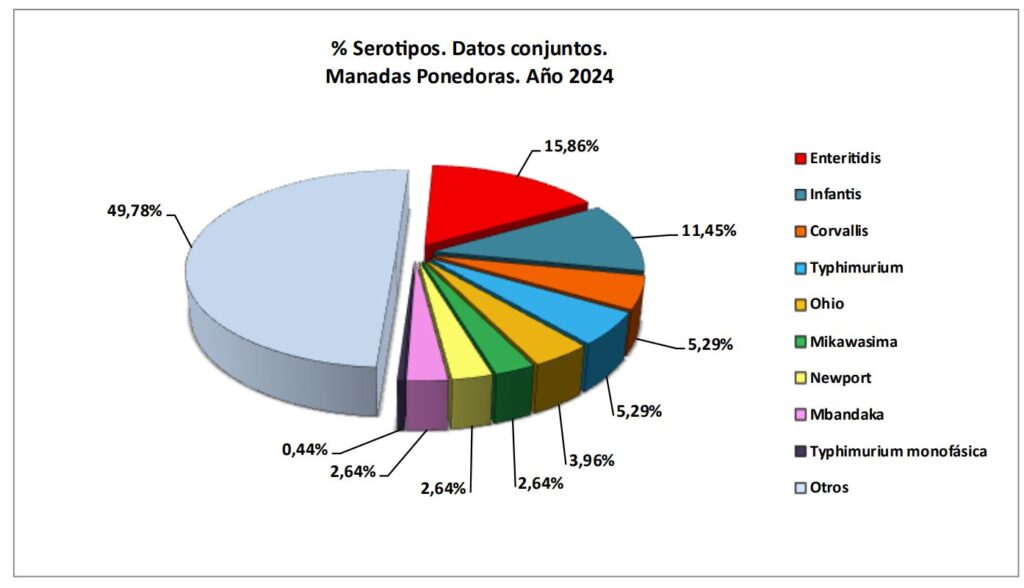
In 2024, the most frequently detected serotype among those identified was “Other” (49.78%), followed by S. Enteritidis (15.86%), S. Infantis (11.45%) and S. Corvallis (5.29%). S. Typhimurium and its monophasic variant together accounted for approximately 3%.
nnnn
nn
nnnn
20. Main reference legislation
nnnn
n
Regulation (EC) 2160/2003: control of Salmonella and other zoonotic agents in primary production.
nnnn
Regulation (EU) 517/2011: testing requirements for laying hens.
nnnn
Regulation (EC) 1177/2006: use of vaccines and antimicrobials in control programmes.
Want to stay one step ahead in poultry farming? Subscribe free to our eNewsletter and receive a weekly selection of the best information to anticipate trends, stay up to date and grow as a poultry industry professional. NeXusAvicultura: Vision, Insight, Quality and Context.