
What if we deliberately selected crops with poultry nutrition in mind?
For decades, crop genetic improvement has focused on the needs of farmers and food market demands in terms of yield, pest resistance, drought tolerance and harvest stability. These priorities have been essential for global food security.
However, one of the largest consumers of these crops, the animal feed production sector has historically been a minor user, rather than an active voice in breeding objectives. As poultry production continues to evolve towards precision nutrition, sustainability and efficiency, it may be time to rethink this relationship. What if we intentionally selected crops with poultry nutrition in mind?
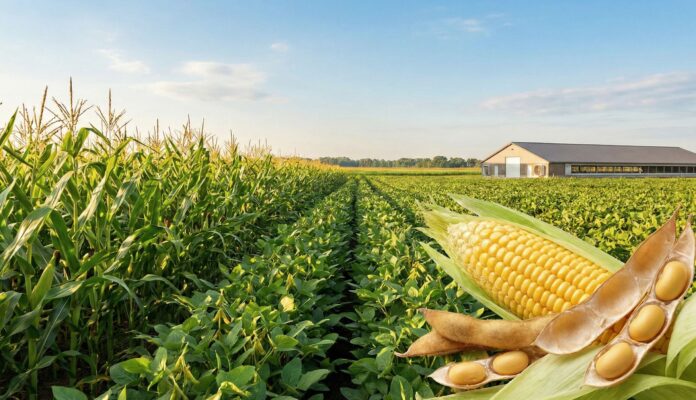
Modern poultry diets rely heavily on a few plant-based ingredients, particularly maize and soybean. These crops were not designed to meet the biological needs of birds; rather, they were bred to thrive in the field. As a result, nutritionists must constantly adapt feed formulations to accommodate the natural variability in nutrient density, digestibility and anti-nutritional factors. Each season, weather patterns, soil conditions and genetic variation reshape the nutritional profile of ration ingredients before they even reach feed mills.
“Instead of continuously adapting diets to crops, we can begin to explore how crops might be adapted to the nutritional needs of animals”
From a plant physiology perspective, this variability is not surprising. Plants allocate resources to survive and reproduce under changing environmental conditions. When crops experience heat, drought or pest pressure, their metabolism shifts. Starch deposition, protein composition, fat content and fibre structure can all change. Even within the same hybrid, the biochemical composition of the grain can vary significantly from one season to the next. For poultry nutritionists seeking precision, this biological reality represents a moving target.
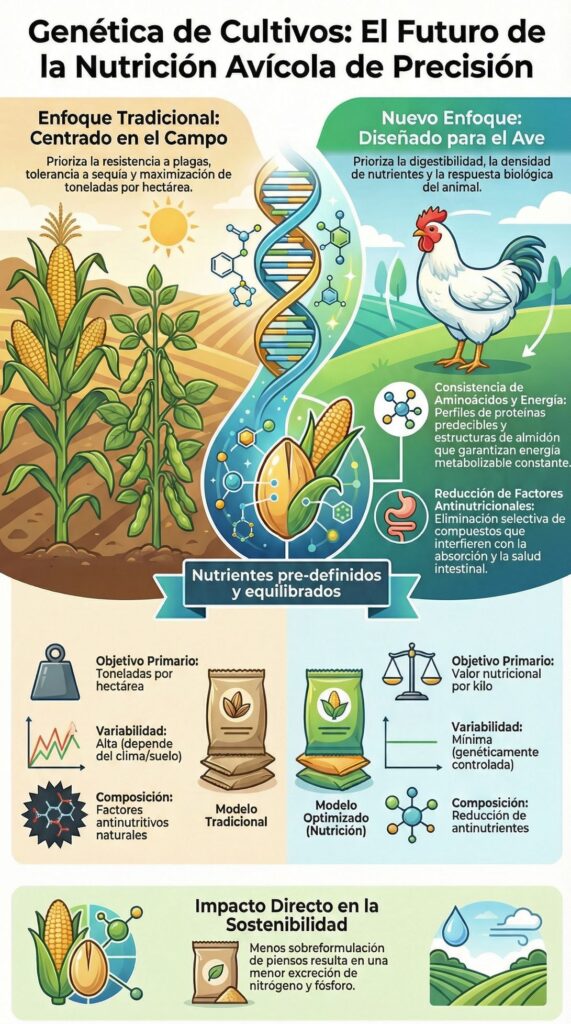
Historically, the animal feed sector has responded by improving analytical, modelling and formulation tools. While these advances are crucial, they treat variability as something to be managed rather than reduced at source. This is where the concept of feed-optimised crop genetics gains traction. Instead of continuously adapting diets to crops, we can begin to explore how crops might be adapted to the nutritional needs of animals.
“Feed-optimised crop genetics is not only a nutritional strategy, but also a sustainability strategy”
Consider the traits of greatest importance in poultry nutrition:
consistent metabolisable energy,
predictable amino acid profiles,
reduced fibre complexity and
lower levels of anti-nutritional compounds.
Each of these traits has a physiological and genetic basis in plants. Starch structure affects energy availability. Protein composition determines amino acid balance. Cell wall architecture influences digestibility. Secondary metabolites, originally evolved for plant defence, can affect gut health and nutrient absorption in birds.
Plant geneticists already manipulate many of these traits for human food markets. High-oleic soybean, waxy maize and low-phytate grains demonstrate that selective improvement based on compositional traits is achievable. Extending this approach to poultry nutrition is a logical next step.
Crops could be developed with more predictable nutrient density, improved digestibility and reduced dependence on additives and formulation safety margins.
“The next frontier could be transforming the way we grow the ingredients themselves”
The potential benefits extend beyond feed efficiency. Feed represents the largest environmental footprint in poultry production. Improving the nutritional consistency of feed ingredients could reduce over-formulation, decrease nitrogen and phosphorus excretion and support more sustainable production systems. In this sense, feed-optimised crop genetics is not only a nutritional strategy, but also a sustainability strategy.
Achieving this vision will require closer collaboration among plant scientists, geneticists, nutritionists and the feed industry. It calls for new thinking on breeding objectives, data sharing and the value chain connecting seed development to animal performance.
Precision nutrition has transformed the way we formulate diets. The next frontier could be transforming the way we grow the ingredients themselves.
Source: Feed Strategy
For further reading:
-. Sustainability in poultry production
Want to stay one step ahead in poultry production?
Subscribe free to our eNewsletter and receive a weekly selection
of the best information to anticipate trends, stay up to date and grow as a poultry industry professional.
NeXusAvicultura: Vision, Criteria, Quality and Context.