
National Salmonella Control Programme in Turkeys (2025-2027) — 2026 Version
At www.NeXusAvicultura.com we do not merely read the BOE; we dissect it. The health of our birds, and therefore the food safety of the poultry meat we deliver to consumers, is not a matter of bureaucracy but of biosecurity.
This programme, which we analyse today, is the mandatory roadmap for the coming years, and after reviewing the 2026 version, we bring you what really matters for every turkey fattening or breeder operation.
Practical summary of the official MAPA programme for Salmonella control in Turkeys
Background and origin of the programme
Between October 2006 and September 2007, a Community baseline study was conducted on the prevalence of Salmonella in turkeys of the species Meleagris gallopavo. Initial results in Spain showed a prevalence of S. Enteritidis and S. Typhimurium of 0% in breeder turkeys and 2.8% in fattening turkeys. When considering Salmonella spp. as a whole, the figures rose to 5.3% and 56.3%, respectively.
Based on that data, Spain has been implementing successive national control programmes. The current programme covers the three-year period 2025-2027, and the document summarised here corresponds to the updated version for 2026, published on 4 March 2026 by the Subdirectorate General for Animal Health, Hygiene and Traceability of the Ministry of Agriculture, Fisheries and Food (MAPA).
1. The objective: the 1% threshold
The programme aims to reduce to 1% or below the prevalence of flocks testing positive for the target serovars, in both fattening turkeys and adult breeding turkeys.
| Population | Prevalence target |
|---|---|
| Fattening turkeys | ≤ 1% of flocks positive for SE/ST |
| Adult breeding turkeys | ≤ 1% of flocks positive for SE/ST |
Note: Given that the census of adult breeding turkey flocks in Spain is fewer than 100, the alternative target for this population is that there should be no more than one positive flock.
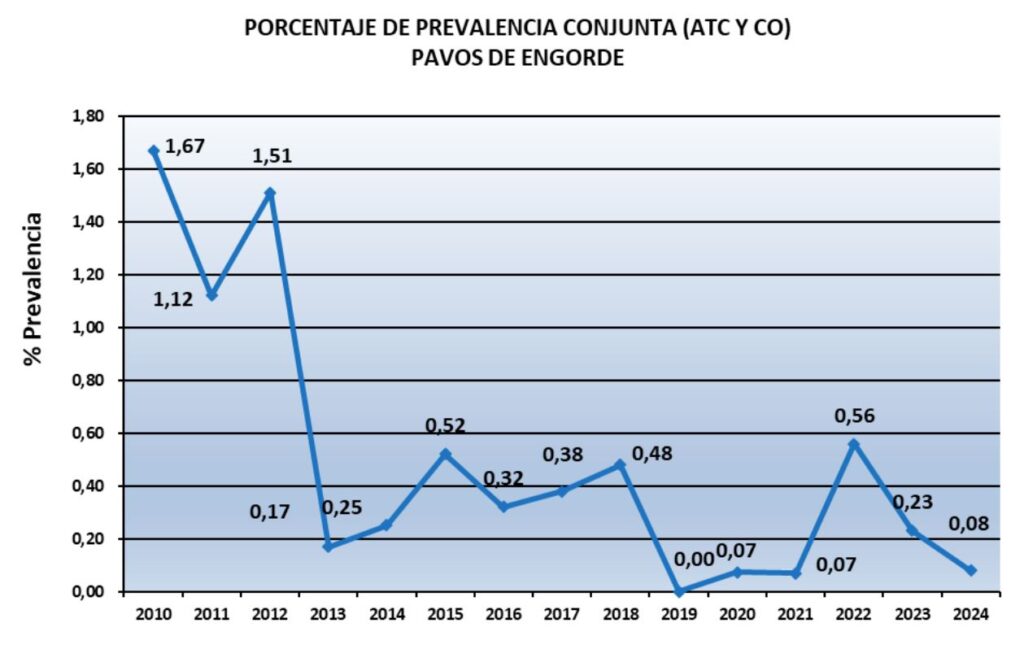
Key figure: In 2024, Spain performed exceptionally well. Prevalence in fattening turkeys was just 0.08%, while in breeders it was 1.16% (a single positive flock).
Target serovars
- Salmonella Enteritidis (SE)
- Salmonella Typhimurium (ST), including monophasic strains with antigenic formula 1,4,[5],12:i:-
Definition of a positive case
A flock is considered positive when:
- The presence of SE or ST (including monophasic strains), other than vaccine strains, is detected at any point in time.
- Antimicrobials or bacterial growth inhibitors are detected in the samples.
Positive flocks are counted only once per production cycle and are reported in the year of the first positive result.
2. Scope of application
- Territory: The entire Kingdom of Spain.
- Populations covered: All turkey breeder and fattening flocks intended for commercial slaughter.
- Exclusions: Holdings producing exclusively for own consumption (private domestic use).
- Holdings supplying directly to the final consumer or to local retail establishments shall carry out at least 1 self-check per year.
Epidemiological unit
The turkey flock: all birds with the same health status, in the same facilities or enclosure, constituting a single epidemiological population. In housed birds, this includes all birds sharing the same air space.
Flock identification
Flocks are identified using a composite code:
REGA + HOUSE (capital letter) + DATE OF BIRD PLACEMENT (mmyyyy)
3. Reporting of results
- Universal obligation: Any natural or legal person (especially veterinarians) must report confirmed or suspected cases of Salmonella to the competent authorities.
- Reporting deadline: Within 24 hours of receiving the results, both by the laboratory and by the holding owner.
- Mandatory serotyping: Laboratories must serotype samples at a minimum to distinguish between the target serovars and other Salmonella spp. serovars.
- Entry into the IT application: Recording of all self-check results in the MAPA application is mandatory.
4. Biosecurity measures
Biosecurity measures are verified at least once a year in all holdings sampled under official control, using specific protocols according to the production type.
Available verification protocols
| Type of holding | Applicable protocol |
|---|---|
| Breeder turkeys | Specific protocol for breeders |
| Fattening turkeys | Specific protocol for fattening |
Areas assessed and maximum scores
Breeder turkey holdings:
| Biosecurity area | Maximum score |
|---|---|
| Access control to the holding | 9 (cage/floor) — 12 (free-range/organic) |
| Facility maintenance | 5 |
| Drinking water control | 2 |
| Manure and waste management | Exclusionary requirement (x0 or x1) |
| Carcass and SANDACH management | 4 |
| Personnel access control to houses | 9 |
| Bird supply | 3 |
| Feed or raw material control | 13 |
| Cleaning, disinfection and disinfestation | 12 |
| Rodent and other animal control | 11 (cage/floor) — 13 (free-range/organic) |
| Veterinary medicinal product control | 2 |
| Veterinary supervision | 1 |
| Management practices and training | 6 |
| Hatchable egg health programme | 13 |
| Self-checks | Exclusionary requirement (x0 or x1) |
Fattening turkey holdings:
| Biosecurity area | Maximum score |
|---|---|
| Access control to the holding | 9 (indoor) — 12 (free-range/organic) |
| Facility maintenance | 5 |
| Drinking water control | 2 |
| Manure and waste management | Exclusionary requirement (x0 or x1) |
| Carcass and SANDACH management | 4 |
| Access control to houses and yards | 9 |
| Bird supply | 11 |
| Feed or raw material control | 13 |
| Cleaning, disinfection and disinfestation | 8 |
| Rodent and other animal control | 11 (indoor) — 13 (free-range/organic) |
| Veterinary medicinal product control | 2 |
| Veterinary supervision | 1 |
| Management practices and training | 6 |
| Self-checks | Exclusionary requirement (x0 or x1) |
Exclusionary requirements (marked with **)
Exclusionary requirements are those whose non-compliance results in a score of x0 (i.e., the total score for the block is multiplied by zero). Some of the most relevant include:
- Perimeter fencing and entry gate in adequate condition.
- No access by wild birds and other animals to feeders or drinkers.
- Water tanks and pipes covered and protected.
- Approved and documented manure management plan.
- Adequate carcass disposal system.
- Feed sourced from authorised suppliers.
- Documented cleaning, disinfection and disinfestation (CDD) programme.
- Efficacy analysis of cleaning and disinfection.
- Minimum downtime of 12 days (or 7 days if efficacy is demonstrated beforehand).
- Updated and documented rodent control plan.
- Veterinary Medicine Register kept up to date.
- Responsible veterinarian with recorded visits.
- Code of Good Hygiene Practices applied.
- All-in/all-out system.
- Official movement health documents.
Consequences for deficiencies
- Written notification to the owner with a correction deadline.
- Proportionate and graduated approach.
- Possible sanctions: ranging from immobilisation of the holding to revocation of the sanitary operating authorisation.
5. Minimum self-check requirements
Sampling frequency by flock type
Fattening turkeys:
nnnn| Phase | Sampling time |
|---|---|
| Adult flocks | Within the 3 weeks prior to dispatch to the slaughterhouse |
| Exception (>100 days or organic) | Sampling may be authorised up to 6 weeks before slaughter |
Breeding turkeys:
nnnn| Phase | Sampling time |
|---|---|
| Rearing flocks — 1 day | On arrival of turkey poults |
| Rearing flocks — 4 weeks | At 4 weeks of age |
| Rearing flocks — Pre-lay | 2 weeks before transfer to the laying phase |
| Adult flocks — Production | Every 3 weeks during the laying period |
| Adult flocks — Pre-slaughter | Within the 3 weeks prior to slaughter |
Persons responsible for sampling
nnnn- n
- Farm owner and responsible veterinarian. nnnn
- Optionally, qualified personnel from the laboratory carrying out the analyses. nnnn
- The responsible veterinarian shall supervise that the protocol is correctly followed. n
Verification of cleaning and disinfection
nnnnIn addition to routine sampling, an environmental sampling to verify the cleaning and disinfection of the house after each depopulation is mandatory. Restocking shall only take place following a negative result.
nnnnRecording of results
nnnn- n
- Results must be recorded in the MAPA computer application “Autocontroles en explotaciones avícolas”. nnnn
- Deadline: Maximum 1 month from the date the result is obtained at the laboratory. nnnn
- Samples not recorded in the application shall not be valid within the PNCS. n
nnnn
6. Sampling protocol
nnnnGeneral instructions for boot swabs
nnnn- n
- Moisten the boot swabs before putting them on with maximum-recovery diluents (0.8% NaCl + 0.1% peptone in sterile deionised water), sterile water or another approved diluent. nnnn
- Each pair of boot swabs must cover approximately 50% of the house floor area. nnnn
- Avoid contamination from disinfectants in footbaths. nnnn
- Carefully remove the boot swabs when finished, without dislodging the adhered material. n
Breeding turkeys in the adult phase
nnnn| Sample type | Description |
|---|---|
| Option A: Faecal mix | Individual fresh faeces (≥1 g), taken at random, according to the table by flock size. Mix to analyse a minimum of 2 samples |
| Option B: Boot swabs and/or dust | 5 pairs of boot swabs (20% of the house per pair), processed as 2 composite samples of 5 swabs each; or 1 pair of boot swabs (entire house) + 1 dust sample |
| Option C: Caged flocks | Mixed faeces from belts, scrapers or pits. Minimum 2 samples of ≥150 g each |
Table of individual faecal samples by flock size (breeders):
nnnn| No. of birds in the flock | No. of individual samples |
|---|---|
| 250–349 | 200 |
| 350–449 | 220 |
| 450–799 | 250 |
| 800–999 | 260 |
| 1,000 or more | 300 |
Fattening turkeys
nnnn- n
- Minimum 2 pairs of boot swabs made of absorbent material. nnnn
- All boot swabs may be combined into a single sample. n
Special cases
nnnn- n
- Free-range turkeys: Samples taken inside the house only. nnnn
- Flocks with fewer than 100 turkeys: If boot swabs cannot be used, replace with manual samples by rubbing the swabs against surfaces contaminated with fresh faeces. n
nnnn
7. Official controls
nnnnIn breeding turkeys
nnnn- n
- Frequency: Once a year. nnnn
- Scope: All flocks with at least 250 adult breeding birds between 30 and 45 weeks of age, and all elite, great-grandparent and grandparent flocks. nnnn
- Also all flocks from holdings where SE/ST has previously been detected. n
In fattening turkeys
nnnn- n
- Frequency: Once a year. nnnn
- Scope: At least one flock from 10% of holdings with at least 500 fattening turkeys. nnnn
- In autonomous communities with 10 holdings or fewer: at least 1 holding. n
Risk criteria for the selection of 10% of holdings
nnnn- n
- Production type and size of the holding. nnnn
- Provincial poultry density. nnnn
- History of previous results. nnnn
- Priority given to holdings with no prior information. nnnn
- Priority given to holdings with unresolved biosecurity non-compliances or previous positive results. n
nnnn
8. Measures for positive flocks
nnnnIf SE or ST is detected (target serotypes)
nnnn- n
- Rigorous epidemiological investigation to identify the source of infection. nnnn
- Rigorous biosecurity control in all flocks on the holding. nnnn
- Immobilisation: No movement of live turkeys is permitted, except with prior authorisation for slaughter or destruction, accompanied by an official health document. nnnn
- Breeding turkeys: Compulsory slaughter or destruction of the entire flock, including day-old poults. nnnn
- Destruction of unincubated eggs from the flock (breeders). Except where treated to ensure elimination of Salmonella. nnnn
- Complete cleaning and disinfection of the house, followed by environmental verification. nnnn
- Prohibition on restocking for 12 days after cleaning and disinfection (reducible to 7 days if efficacy is analytically demonstrated). nnnn
- Communication of dates (bird removal, disinfection, environmental sampling, restocking) to the competent authorities. nnnn
- Possibility of requesting testing of workers caring for the animals. n
If a non-target serotypeIs detected
nnnn- n
- Rigorous epidemiological investigation. nnnn
- Rigorous biosecurity control. nnnn
- In the event of recurring positives, notification to the competent authority of the establishment of origin (hatchery or breeding flocks). n
nnnn
9. Slaughterhouse management of SE/ST-positive flocks
nnnn- n
- The holding operator must include in the FCI (Food Chain Information) the results of the most recent Salmonella analysis of the flock sent for slaughter. nnnn
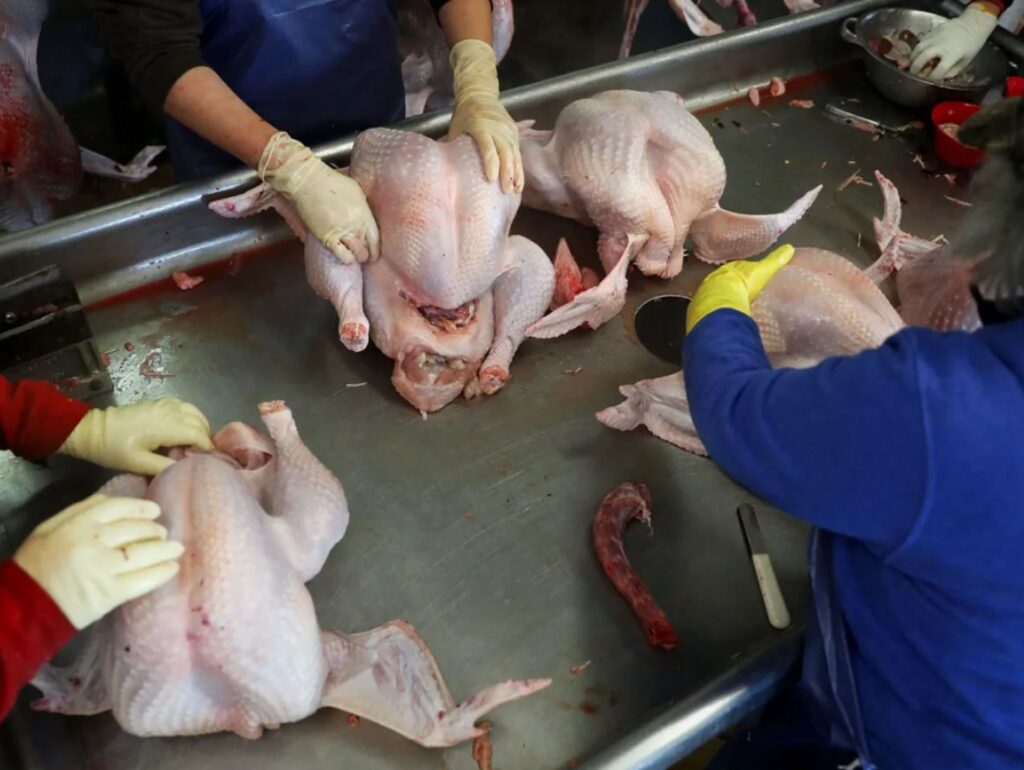
- Positive flocks are slaughtered by means of logistic slaughter: in the last slot of the daily slaughter order, followed by cleaning and disinfection. nnnn
- Slaughterhouses must include in their sampling plans carcasses from flocks that are positive or of unknown SE/ST status. nnnn
- The meat must meet the criterion: absence of SE/ST in 5 samples of 25 g (Regulation (EC) No 2073/2005). n
nnnn
10. Laboratories
nnnnNational Reference Laboratory (NRL)
nnnnCentral Veterinary Laboratory of the MAPA, located in Algete (Madrid).
nnnnRequirements for participating laboratories
nnnn| Aspect | Requirement |
|---|---|
| Designation | Established, recognised or designated by the autonomous communities |
| Accreditation | Standard EN/ISO 17025, for detection of Salmonella in all matrices covered by the PNCS |
| Interlaboratory comparison | Participation in collective proficiency tests organised by the NRL |
| Validity of results | Throughout the national territory |
- n
- If the same laboratory acts as both official and self-monitoring laboratory, it must notify the authorities and ensure the separation of both activities. nnnn
- Laboratories must reject samples that do not meet the programme requirements. n
nnnn
11. Detection method and serotyping
nnnn- n
- Method: Standard EN/ISO 6579-1 (Amendment 1, Amd1:2020), using semi-solid MSRV (modified Rappaport-Vassiliadis) medium as the sole selective enrichment medium. nnnn
- MSRV incubation: 41.5 ± 1 °C for 2 × (24 ± 3) hours. nnnn
- Serotyping: Minimum one strain per positive sample, according to the Kaufmann-White–Le Minor scheme. nnnn
- Alternative methods: Permitted if validated according to EN ISO 16140 and registered with the MAPA. n
Deadlines for serotyping
nnnn| Step | Maximum deadline |
|---|---|
| Dispatch of isolate to another laboratory for serotyping | 24 hours after isolation |
| Start of serotyping at the receiving laboratory | 24 hours after receipt |
| Issue and dispatch of results report | 24 hours after obtaining the result |
Strain preservation
nnnn- n
- Official control strains will be sent to the LNR (Algete). nnnn
- Minimum preservation of 2 years, guaranteeing the integrity of the strains. n
nnnn
12. Transport and dispatch of samples
nnnn| Aspect | Requirement |
|---|---|
| Containers | Sterile and hermetically sealed |
| Dispatch deadline | 24 hours after collection |
| If not dispatched within 24 h | Refrigerate |
| Transport temperature | Ambient, avoiding >25 °C and sun exposure |
| Start of laboratory examination | Within 48 hours of receipt and within 96 hours of sampling |
nnnn
13. Official feed controls
nnnn- n
- Verification of compliance with feed hygiene regulations (Regulation (EC) 183/2005). nnnn
- Feed operators must implement HACCP systems and ensure that feed does not transmit Salmonella. nnnn
- There is no harmonised microbiological criterion for Salmonella in raw materials and feed of plant origin at either Community or national level. nnnn
- If S. Enteritidis, S. Typhimurium, S. Infantis, S. Virchow or S. Hadar is detected in feed, notification through the Alert Network is initiated. nnnn
- Each year, more than 3,000 inspections are carried out at animal feed establishments and more than 1,000 official samples are taken for microbiological analysis. n
nnnn
14. Verification of cleaning and disinfection following a positive flock
nnnnProcedure
nnnn- n
- Complete cleaning: Including total removal of litter and droppings. nnnn
- Disinfection, insect control and rodent control using authorised products. nnnn
- Collection of environmental samples (after an adequate period post-disinfection):n
- n
- Minimum 2 swabs of ≥900 cm² each, wiped over floors, walls, feeders, drinkers, fans, beams, pipes and hard-to-clean points. nnnn
- Swabs moistened with suitable diluents before sampling. n
nnnn - Analysis at PNCS-authorised laboratories, using the same method as for the remaining samples. nnnn
- If Salmonella spp. is detected, repeat cleaning and disinfection until a satisfactory result is obtained. n
Restocking deadlines
nnnn| Situation | Minimum deadline |
|---|---|
| General rule | 12 days after cleaning, disinfection and pest control (LDD) |
| With analytical results demonstrating efficacy | Reducible to 7 days |
In both cases, restocking only takes place if the environmental analyses are satisfactory and biosecurity deficiencies have been corrected.
nnnnnnnn
15. Vaccination
nnnn- n
- Not mandatory. nnnn
- If applied, only vaccines with a marketing authorisation from the AEMPS or the European Commission are permitted. nnnn
- It must be recorded in the veterinary medicinal product treatment register and in the MAPA computer application. nnnn
- If a vaccine strain is identified, the flock is considered negative. n
nnnn
16. Compensation to owners
nnnn- n
- Owners are entitled to compensation when the competent authority orders compulsory slaughter, provided they have complied with animal health regulations. nnnn
- The scales are set out in RD 823/2010. nnnn
- The age of the birds for compensation purposes is that at the time the slaughter order is issued. n
nnnn
17. Institutional structure and coordination
nnnn| Level | Responsible body | Main function |
|---|---|---|
| National (coordination) | Subdirectorate-General for Animal Health, Hygiene and Traceability — MAPA | Programme development and coordination; liaison with the European Commission |
| Regional (implementation) | Competent bodies of the Autonomous Communities | Direct implementation and monitoring of the programme |
| Committee | National Committee of the Veterinary Sanitary Alert System | Coordination between administrations, study of measures, epidemiological monitoring |
| Reference laboratory | Central Veterinary Laboratory (Algete, Madrid) | Reference for all Salmonella serotypes in animals |
nnnn
18. Prevalence trends (historical data)
nnnnFattening turkeys (combined ATC + CO prevalence)
nnnn| Year | % SE/ST Prevalence |
|---|---|
| 2010 | 1.67 |
| 2011 | 1.12 |
| 2012 | 1.51 |
| 2013 | 0.17 |
| 2014 | 0.25 |
| 2015 | 0.52 |
| 2016 | 0.32 |
| 2017 | 0.38 |
| 2018 | 0.48 |
| 2019 | 0.00 |
| 2020 | 0.07 |
| 2021 | 0.07 |
| 2022 | 0.56 |
| 2023 | 0.23 |
| 2024 | 0.08 |
Breeding turkeys (combined ATC + CO prevalence)
nnnn| Year | % SE/ST Prevalence |
|---|---|
| 2010 | 5.88 |
| 2011 | 0.00 |
| 2012 | 0.00 |
| 2013 | 0.00 |
| 2014 | 0.00 |
| 2015 | 0.00 |
| 2016 | 0.00 |
| 2017 | 2.94 |
| 2018 | 0.97 |
| 2019 | 0.00 |
| 2020 | 0.00 |
| 2021 | 0.00 |
| 2022 | 1.12 |
| 2023 | 0.00 |
| 2024 | 1.16 |
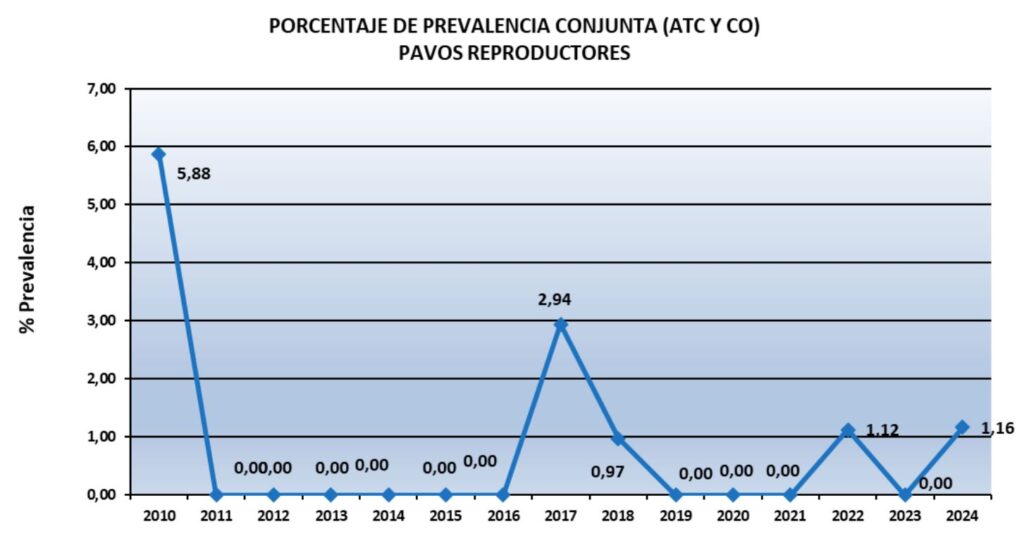
In 2024, the EU reduction target has been met in both populations. The only positive breeding turkey flock was due to a single finding of a Salmonella serotype subject to control.
Most frequent serotypes in fattening turkeys (2024)
nnnnThe predominant non-target serotypes were S. Derby (24.03%), S. Saintpaul (19.38%) and S. Bovismorbificans (16.28%). Among the target serotypes, monophasic S. Typhimurium is the most prevalent.
nnn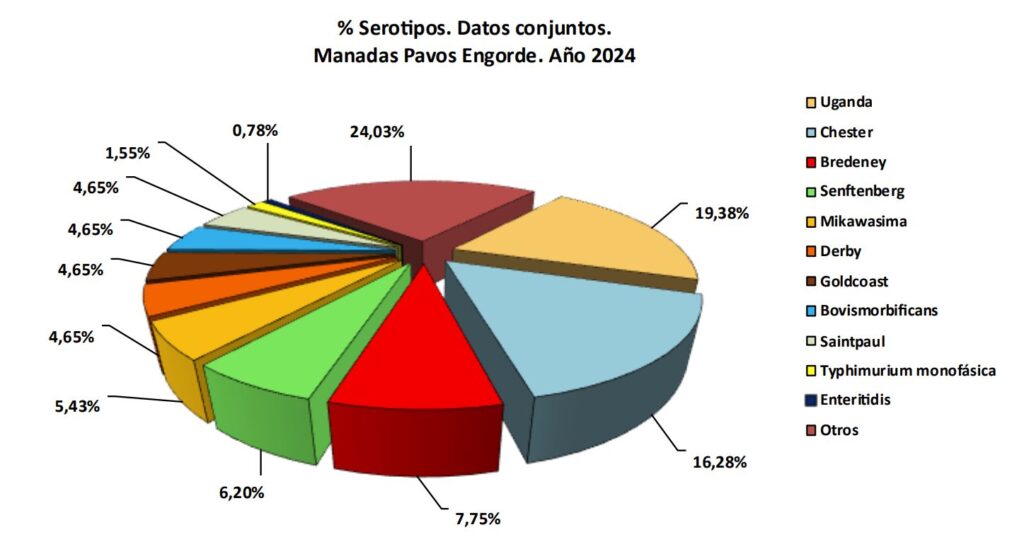
Serotypes in breeding turkeys (2024)
nnnnThe predominant serotype was S. Chester (57.14%), followed by S. Bovismorbificans (17.86%) and S. Kentucky (14.29%).
nnn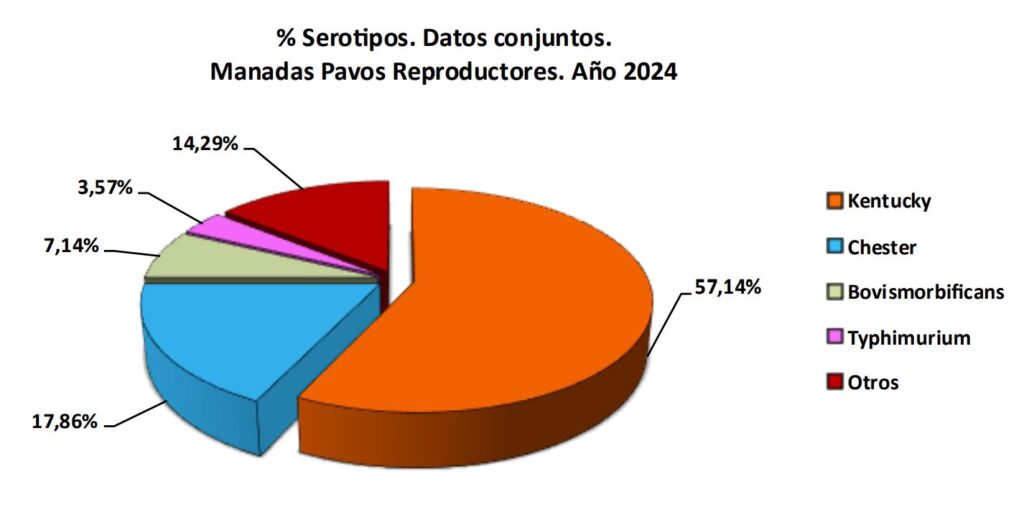
nnnn
19. Main legal basis
nnnn- n
- Regulation (EC) No 2160/2003 — Control of Salmonella and other zoonotic agents in the food chain. nnnn
- Regulation (EU) No 1190/2012 — Salmonella reduction target in turkeys. nnnn
- Regulation (EC) No 2073/2005 — Microbiological criteria applicable to foodstuffs. nnnn
- Regulation (EC) No 1177/2006 — Requirements for the use of specific control methods (antimicrobials and vaccines). nnnn
- Regulation (EC) No 852/2004 — Hygiene of foodstuffs. nnnn
- Regulation (EC) No 853/2004 — Specific hygiene rules for food of animal origin. nnnn
- Regulation (EC) No 183/2005 — Feed hygiene requirements. nnnn
- Regulation (EC) No 1069/2009 — Animal by-products not intended for human consumption. nnnn
- Regulation (EU) 2019/627 — Official controls on products of animal origin. nnnn
- Law 8/2003 — Animal Health. nnnn
- Royal Decree 637/2021 — Basic regulations for the organisation of poultry farms. nnnn
- Royal Decree 479/2004 — General register of livestock holdings. nnnn
- Royal Decree 823/2010 — Compensation scales for compulsory slaughter. n
nnnn
20. Animal welfare
nnnnWhen a sanitary depopulation is ordered, the document “Protection of animals during killing in sanitary depopulations” shall be applied simultaneously, in accordance with Council Regulation (EC) No 1099/2009 on the protection of animals at the time of killing. The competent authorities must safeguard animal welfare and inform the European Commission of the actions taken.
nnnnnnnn
List of Salmonella vaccines authorised in Spain (updated June 2025)
nnnnnnnn
Disclaimer / Important notice:
This summary has been prepared by NeXusAvicultura.com based on the official document «National Control Programme for Certain Salmonella Serovars in FATTENING TURKEYS and BREEDING TURKEYS 2025-2027, 2026 Version«, published by the General Sub-Directorate for Animal Health, Hygiene and Traceability of the Ministry of Agriculture, Fisheries and Food (MAPA).
It is for information purposes only and does not replace the legal text, which can be consulted in full (53 pages) on the MAPA website.
nnnn
To find out more:
-. Salmonella in poultry farming
-. Basic regulations and general aspects of Salmonella Control Programmes
-. MAPA’s main page on Salmonella Control in poultry farming
-. Summary of the 2026 Salmonella Control Programme for fattening and breeding TURKEYS. (25 March 2026)
-. Summary of the 2026 Salmonella Control Programme for BREEDER hens. (17 March 2026)
-. Summary of the 2026 Salmonella Control Programme for BROILER chickens. (23 Feb 2026)
-. Summary of the 2026 Salmonella Control Programme for LAYING HENS. (17 Feb 2026)
nnnn
Do you want to stay one step ahead in poultry farming?
Subscribe for free to our eNewsletter and receive a weekly selection
of the best information to anticipate trends, stay up to date and grow as a poultry industry professional.
NeXusAvicultura : Vision, Insight, Quality and Context.