
The importance of sustaining egg promotion campaigns over time
If egg consumption in Spain has grown by 16.7% since 2019, it is not solely due to its nutritional qualities or its affordable price: behind it lies a sustained body of sector-wide promotional work that INPROVO has been carrying out for years, thanks in large part to the financial muscle provided by the standard extension funds for 2020–2023 and 2023–2027, and which is now entering a new European phase with ‘EU EGGS, 3 TIMES GOOD’
When a food product achieves year-on-year growth in consumption within a food market that barely moves or even contracts, it is worth asking why. Eggs have achieved this in Spain in a sustained manner: +16.7% in volume since 2019, equivalent to 1,253 million more eggs per year in Spanish households, according to data from the Egg Consumption Observatory in Spain compiled by INPROVO. In 2024, while overall food consumption recorded -0.2% in volume, eggs grew by 2.9%, consolidating their position as the fresh food category that advanced most.
“‘If the egg did not exist, it would have to be invented.’ This is the premise behind INPROVO’s new European campaign, a 36-month programme with a budget of €2.9 million.”
It is tempting to attribute this growth exclusively to the product’s intrinsic qualities: high biological-value protein, culinary versatility and a cost of less than €30 per person per year. All of this is true. However, reducing the explanation to these factors alone would be to overlook an essential component of success: the continuous, strategic and sustained promotional work that the Egg and Egg Products Interprofessional Organisation (INPROVO) has been carrying out since the sector’s standard extension was approved.
Egg marketing must be treated as a fixed structural cost (investment), on a par with biosecurity or feed.
There is an understandable but mistaken tendency to assume that staple foods require no promotion. Eggs have been part of the human diet for centuries, are present in 97% of Spanish households and feature in three of the fifteen most widely consumed dishes in the country (Spanish omelette, French omelette and fried eggs). Why invest in communicating something that everyone already consumes?
The answer lies in the data. Before INPROVO launched its first promotional campaigns, egg consumption in Spain showed a slightly downward trend or, at best, stagnation. It was the production sector that individually funded isolated actions, without the critical mass or strategic coherence needed to change habits at a national scale.
Although earlier campaigns had existed, the turning point was marked by the approval of the standard extension (the first covering 2020–2023 and the second covering 2023–2027), which provided the interprofessional organisation with the necessary financial resources — drawn from the mandatory contributions of all sector operators — to plan and execute campaigns with genuine reach.
Since then, INPROVO has linked together successive communication programmes following a cumulative logic: each campaign has built on the previous one, without any significant interruption.
“Consumption does not grow simply because a food is good and AFFORDABLE.
It grows when someone takes care,
year after year, to ensure that consumers remember it, value it and choose it.”
The campaigns that have helped change perceptions of eggs
To understand the importance of continuity, it is worth reviewing the main campaigns that INPROVO has recently deployed (prior to these, other campaigns had been run since the founding of ASEPRHU in 1994):
“Today, Egg. Nourishing body and mind” (2022–2023). This was the first major national campaign funded by standard extension resources. Launched in January 2022 with seven television spots — one for each day of the week — it targeted specifically the two groups with the lowest consumption: families with children (40% below average) and young households without children (13% below average). The campaign was underpinned by a report from the Universidad Complutense de Madrid endorsing the consumption of up to one egg per day for children and adolescents, giving the message a scientific basis.

“The European Egg Games” (2023–2025). A three-country campaign co-financed by the EU, developed together with the sector organisations of France (SNIPO) and Hungary (PPB). It used gamification to reach Generation Z and families with children through challenges on Instagram and TikTok, culminating each year with a special challenge around World Egg Day. The format was innovative and demonstrated that egg promotion could be adapted to the communication codes of younger audiences.
#Saludoble (2024–2025). A natural evolution of “Today, Egg”, this campaign centred the message on a memorable concept that encapsulated the dual benefit of eggs for body and mind. It aired on Mediaset, Amazon, Netflix, YouTube, social media and 63 buses in 12 Spanish cities, reaching more than 30 million people with an investment of under €400,000. Its second wave in 2025 coincided with World Egg Day.
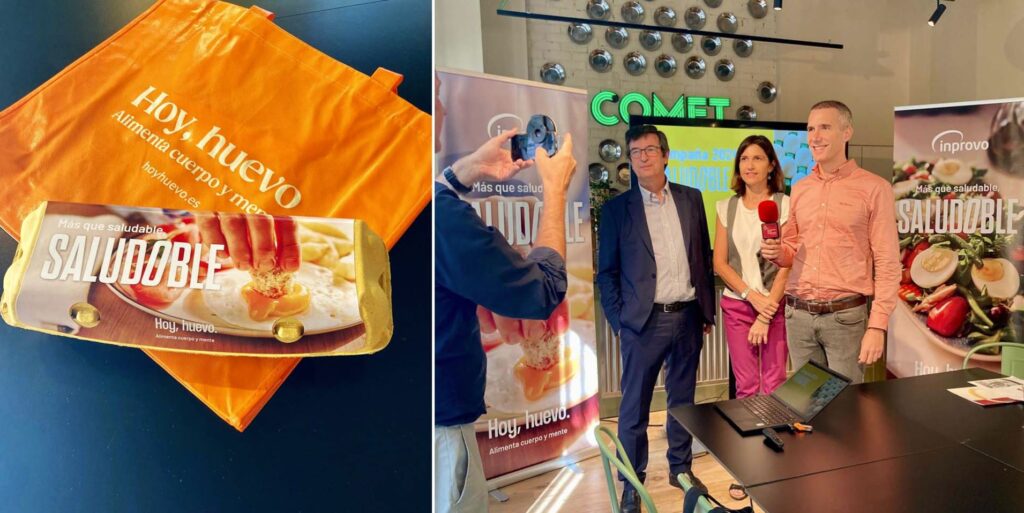
“Each INPROVO campaign has built on the previous one.
There is a cumulative strategy that steadily reinforces the consumer’s perception of eggs.”
Recent egg promotion campaigns carried out by INPROVO and their results
| CAMPAIGN | PERIOD AND CHARACTERISTICS |
| Today, Egg | 2022–2023 · 7 national TV spots · Targeted at families with children and young people · Standard extension |
| The European Egg Games | 2023–2025 · EU trinational campaign (Spain, France, Hungary) · Gamification · European co-financing |
| #Saludoble | 2024–2025 · TV, streaming, social media, buses · 30M reach · <€400,000 investment |
| EU EGGS, 3 TIMES GOOD | 2026–2029 · 36 months · Spain and Hungary · €2.9M budget · EU co-financing |
| 2024 Consumption | 420 M kg | 143 eggs/person | €1,354 M | 97% household penetration |
| Growth 2019–2024 | +16.7% volume | +58% value | +1,253 M eggs/year |
| Spain Production | 3rd EU producer | 1,169 M dozen | 14% of EU output |
The new campaign: “EU EGGS, 3 TIMES GOOD”
And now, without interruption, the next piece of the puzzle arrives. INPROVO has just launched the development of “EU EGGS, 3 TIMES GOOD”, a European information programme co-financed with EU funds that will run over the next 36 months in Spain and Hungary. The budget amounts to €2.4 million for Spain and €525,000 for Hungary. The Hungarian component will be implemented by the “Baromfi Termék Tanács” (Hungarian Poultry Product Council).
“€2.4 million and 36 months: INPROVO launches its most ambitious European bid to enhance the value of eggs”
The campaign is built around a powerful creative premise: “If the egg did not exist, it would have to be invented.” Under this concept, INPROVO aims to convey that eggs are a “three times good” food: for their benefits to body and mind, for their contribution to the sustainability of the planet, and for their versatility and flavour in everyday gastronomy.
In addition to its nutritional focus, the campaign strengthens awareness of the European production model, a system that guarantees animal welfare, full traceability and environmental protection. The primary target audience is again children and young people, where previous studies indicate proportionally low consumption both in Spain and Hungary.
Luz Santos, Director of INPROVO, noted on the occasion of this new campaign that the Spanish poultry sector is demonstrating its commitment to sustainability and animal welfare, continuously adapting to new consumer demands, and that the strong economic results of recent years are facilitating the maintenance of these commitments, which require substantial investment.
nnnnA sector that backs promotional investment with record figures
nnnnThe new campaign arrives at a time of strength for the sector. Household consumption has maintained a positive trend, with a 3% increase between January and October 2025 compared to the same period in 2024. In 2024, Spanish households spent 1,354 million euros on egg purchases, with consumption of 420 million kilograms (143 eggs per person, six more than in 2023). The sector’s value has grown by 58% since 2019, almost 500 million euros more.
nnnnSpain remains the third largest egg producer in the EU with 1,169 million dozens in 2024, representing 14% of Community production. And the sector has decisively advanced in the transition to alternative systems: 76% of farms already operate with cage-free models and 35.9% of hens are housed in these systems, a growth of close to 10% compared to the previous year.
nnnnThese figures are not unrelated to the promotional effort. INPROVO’s chain of campaigns has helped raise the perception of eggs as a modern, healthy food compatible with the contemporary consumer’s concerns about animal welfare and sustainability. Without that sustained narrative, consumption growth would, in all likelihood, have been significantly lower.
nnnn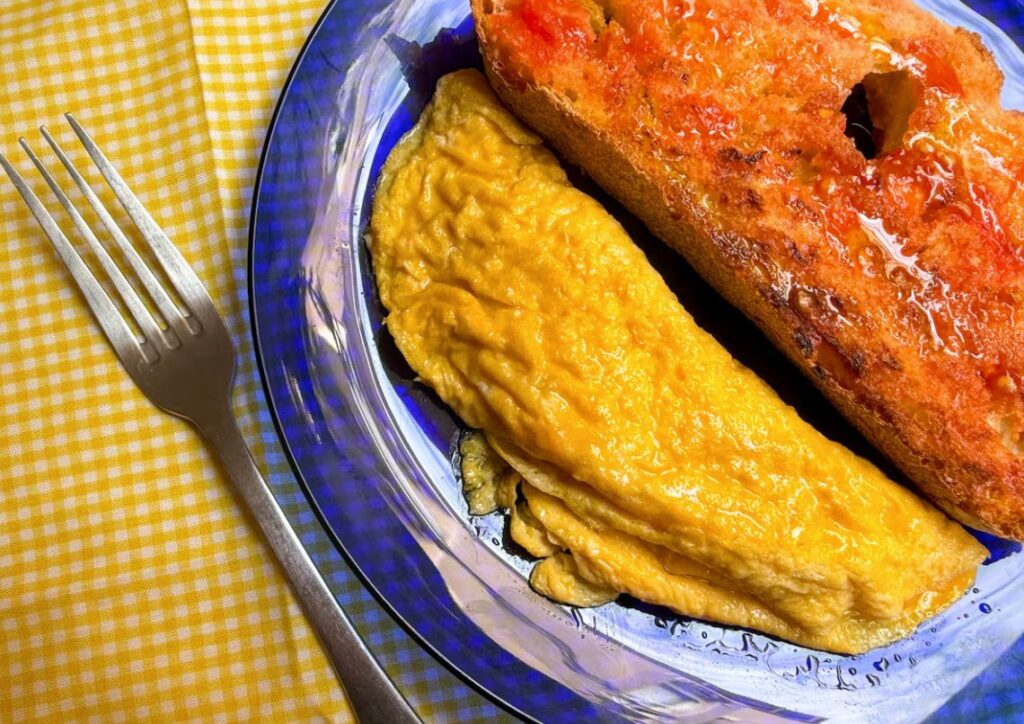
The lesson for the sector: consistency communicates more than intensity
nnnnThere is a well-known principle in marketing that applies precisely to the case of eggs: the effectiveness of communication does not depend solely on one-off investment, but on the continuity of the message over time. An isolated campaign can generate a peak in awareness, but only sustained repetition — with creative variations that avoid saturation — manages to modify perceptions and consumption habits.
nnnnINPROVO has understood this and has executed it with remarkable consistency. From “Hoy, Huevo” to “Los Juegos del Huevo Europeo“, from “#Saludoble” to “EU EGGS, 3 TIMES GOOD“, the common thread is the same: eggs are good for you, good for the planet and produced under the most demanding standards in the world. What changes is the format, the tone and the channel, adapting to each audience and each moment.
nnnnAnd the results speak for themselves: an egg market that grows when the rest of the food sector stagnates or declines, a household penetration rate of 97%, a breakfast that increasingly includes eggs (already in 4.1% of consumption occasions, 1.5 percentage points more than in 2019) and a product image that has shifted from “cheap basic food” to “cross-cutting reference protein”.
nnnnnnnnn“A sector that collectively invests in communicating the value of its product not only protects its market: it expands it. The case of the Spanish egg is the best proof.”
n
Looking ahead: 36 months of opportunity
nnnnWith “EU EGGS, 3 TIMES GOOD”, INPROVO enters a new three-year cycle with European funding, a framework that allows it to broaden the reach of its communication and reinforce its international dimension. The challenge is no small one: it is necessary to keep winning over young consumers, consolidate the presence of eggs at breakfast (a territory with enormous potential in Spain) and counter possible negative narratives linked to avian influenza or debates on animal welfare.
nnnnnnnnn“The effectiveness of communication does not depend solely on one-off investment, but on the continuity of the message over time. INPROVO has spent years demonstrating this with measurable results.”
n
But if INPROVO’s track record has shown anything, it is that consistency works. And that a sector that collectively invests in communicating the value of its product not only protects its market: it expands it. The Spanish egg has the foundations — nutritional, productive and economic — to keep growing. Sustained promotion is what turns those foundations into real consumption.
nnnnFederico Castelló
Director and Founder of NeXusAvicultura
nnnn
For more information:
-. Website of INPROVO and News about the Egg Interprofessional Organisation and its products
-. Poultry farming in Spain
-. Egg marketing
-. First extension of rules for the Spanish egg (Order APA/793/2020, of 6 August 2020, in force from 16 August 2020 to 15 August 2023, three years)
-. Second extension of rules for the Spanish egg (Order APA/817/2023 of 10 July 2023, in force from 16 August 2023 to 15 August 2027, five years)