
National Salmonella Control Programme in Breeder Hens 2025–2027 (2026 Version): Practical Summary
Background and context: where we stand
nnnnThis programme is not a national initiative taken at will; it derives from Regulation (EC) No 2160/2003 and aims to meet European Union objectives. The target in Spain remains clear: to reduce the prevalence of the 5 “top” serovars to a maximum of 1% in flocks of more than 250 adult birds.
nnnnSurveillance in Spain has been active since 1993, but the pressure on biosecurity and traceability has never been as high as in this 2026 version.
nnnnThe Magnificent 5: target serovars
nnnnThe programme targets five specific serovars. If any of these are detected, there is a problem:
nnnn- n
- S. Enteritidis nnnn
- S. Typhimurium (including the monophasic variant 1,4,[5],12:i:-) nnnn
- S. Infantis nnnn
- S. Virchow nnnn
- S. Hadar n
Key fact: A flock is considered positive not only when the bacterium is isolated. If antimicrobials or bacterial growth inhibitors are detected, the flock is automatically deemed positive for the purposes of the EU objective. Treatments must therefore be managed with great care.
nnnn
Where did we start?
nnnnIn 2004, Spain conducted a baseline study in Gallus gallus breeder flocks, which revealed a prevalence of 16.6% for the 5 target serovars and 20.3% for Salmonella spp. in general. Starting from that baseline figure, successive national programmes have been implemented, achieving a dramatic reduction in prevalence to 0.78% by 2024, comfortably meeting the EU target of 1%.
nnn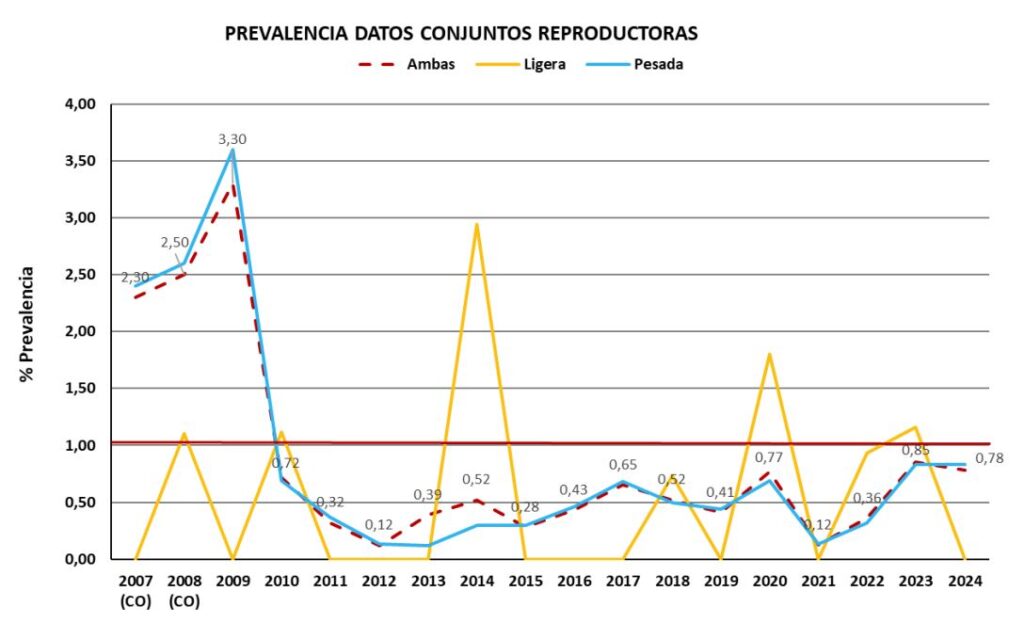
The current programme covers the three-year period 2025–2027, and this version, published in February 2026, incorporates the updates corresponding to 2026. It is developed and coordinated by the Subdirectorate General for Animal Health, Hygiene and Traceability of the Ministry of Agriculture, Fisheries and Food (MAPA), and implemented by the Autonomous Communities throughout Spanish territory.
nnnnnnnnnnnn
1. Programme Objective
nnnnTo control and reduce the presence of 5 Salmonella serovars in Gallus gallus breeder hen flocks, maintaining prevalence below 1% in flocks with more than 250 adult birds.
nnnnTarget serovars:
nnnn- n
- Salmonella Enteritidis (SE) nnnn
- Salmonella Typhimurium (ST), including the monophasic variant (antigenic formula 1,4,[5],12:i:-) nnnn
- Salmonella Infantis (SI) nnnn
- Salmonella Virchow (SV) nnnn
- Salmonella Hadar (SH) n
nnnn
2. Scope of Application
nnnn| Aspect | Detail |
|---|---|
| Territory | The entire Kingdom of Spain |
| Species | Breeder hens of the species Gallus gallus |
| Phases | Adult breeders and breeder pullet rearing |
| Holdings covered | All holdings authorised and registered by the competent authorities |
| Exclusions | Holdings producing primary products intended for self-consumption (private domestic use) |
Epidemiological unit: the flock, defined as all birds with the same health status sharing the same housing or airspace.
nnnnFlock identification: REGA code + building letter (uppercase) + date of bird placement (format mmyyyy).
nnn
nnnn
3. Definition of a Positive Case
nnnnA breeder flock is considered positive when:
nnnn- n
- The presence of any of the 5 target serovars (other than vaccine strains) is detected in one or more samples, or nnnn
- Antimicrobials or bacterial growth inhibitors are detected in the flock. n
Single-count rule: a positive flock is recorded only once per production period, regardless of how frequently detection occurs.
nnnnnnnnn“The objective remains firm:
n
less than 1% prevalence
in adult flocks for the 5 key
Salmonella serovars.”
nnnn
4. Mandatory Notification
nnnn- n
- Every natural or legal person (especially veterinarians) must notify confirmed or suspected cases of Salmonella. nnnn
- Notification to the competent authority must be made within 24 hours of the results becoming known. nnnn
- It is mandatory to enter all self-check results into the MAPA computer application. nnnn
- Laboratories must serotype samples to distinguish at minimum between the 5 target serovars and other serovars. n
nnnn
5. Sampling Frequency
nnnn5.1. Operator self-checks
nnnn| Phase | Sampling point |
|---|---|
| Rearing flocks — Day-old chicks | Upon receipt of the chicks at the holding |
| Rearing flocks — 4 weeks | At 4 weeks of age |
| Rearing flocks — Pre-transfer | 2 weeks before entering the laying phase |
| Adult breeders | Every 2 weeks during the laying phase (extendable to 3 weeks if the EU target has been met for 2 consecutive years) |
Additionally: environmental verification sampling after each house cleaning and disinfection.
nnnn5.2. Official controls (carried out by the competent authority)
nnnn| Control | Timing |
|---|---|
| 1st official control | Within 4 weeks of transfer to the laying unit |
| 2nd official control | During the production period, sufficiently separated from the other two controls |
| 3rd official control | Towards the end of the laying phase (no earlier than 8 weeks before the end of the cycle) |
If the EU target has been achieved for 2 consecutive years, the competent authority may reduce controls to 2 official controls per production cycle (most Autonomous Communities apply this derogation).
nnn
nnnn
6. Sample Types and Sampling Protocol
nnnn6.1. Day-old chicks (rearing)
nnnnOne of the following three options may be used:
nnnn- n
- Option 1: Swabs of the inner liners (box liners) from 10 transport boxes. nnnn
- Option 2: Liver, caecum and yolk sac from 60 chicks (processed as a single sample). nnnn
- Option 3: Meconium from at least 250 chicks. n
6.2. Birds at 4 weeks of age and pre-transfer (rearing)
nnnnTwo options:
nnnn- n
- Fresh faeces: portions of ≥1 g, collected from a minimum of 10 points within the house, pooled into at least 2 composite samples. The number of portions depends on the flock size: n
| No. of birds in the house | Faecal portions to collect |
|---|---|
| 1–24 | Equal to the number of birds (maximum 20) |
| 25–29 | 20 |
| 30–39 | 25 |
| 40–49 | 30 |
| 50–59 | 35 |
| 60–89 | 40 |
| 90–199 | 50 |
| 200–499 | 55 |
| 500 or more | 60 |
- n
- Boot swabs: 5 pairs, processed in the laboratory as 2 composite samples of 5 swabs each. n
6.3. Adult breeders (operator self-check and official control)
nnnnTwo options:
nnnn- n
- Fresh faeces (≥1 g per portion, collected at random), in a minimum of 2 composite samples: n
| No. of birds in the flock | No. of faecal portions |
|---|---|
| 250–349 | 200 |
| 350–449 | 220 |
| 450–799 | 250 |
| 800–999 | 260 |
| 1,000 or more | 300 |
- n
- Boot swabs: 5 pairs, processed as 2 composite samples of 5 swabs each. n
6.4. Specific instructions by production system
nnnn- n
- Caged flocks: naturally mixed faeces from collection belts, scrapers or manure pits. Minimum 2 samples of ≥150 g each. n
nnnnn“In rearing, sampling is non-negotiable:
n
day 1,
week 4
and two weeks before transfer.
No exceptions.”
nnnn
7. Analytical method
nnnn- n
- Reference standard: EN/ISO 6579-1 (Amendment 1 — EN/ISO 6579-2017/Amd1:2020). nnnn
- Enrichment medium: modified semi-solid Rappaport-Vassiliadis medium (MSRV), incubated at 41.5 ±1 °C for 2 × (24 ±3) hours. nnnn
- Serotyping: in accordance with the Kaufmann-White-Le Minor scheme, at least 1 strain per positive sample. nnnn
- Alternative methods: permitted if validated in accordance with EN ISO 16140 and registered with the MAPA. nnnn
- Maximum time limits for serotyping: n
| Stage | Maximum time limit |
|---|---|
| Sending of isolate to another laboratory | 24 h after isolation |
| Start of serotyping at the receiving laboratory | 24 h after receipt |
| Issue and dispatch of results report | 24 h after obtaining the result |
nnnn
8. Transport and storage of samples
nnnn- n
- Samples must be sent to the laboratory within 24 hours of collection (preferably by express mail or courier). nnnn
- If not dispatched within 24 h, they must be stored refrigerated. nnnn
- Transport at ambient temperature is acceptable provided excessive heat (>25 °C) and direct sunlight are avoided. nnnn
- In the laboratory: keep refrigerated; examination within 48 h of receipt and 96 h of sampling. n
nnnn
9. Biosecurity measures
nnnnBiosecurity measures are verified through a verification protocol with scores per area. The elements assessed include 15 thematic blocks, with exclusionary requirements (marked with **) that invalidate the score if not met:
nnnn| Block | Max. score | Key aspects |
|---|---|---|
| 1. Access control to the holding | 9–12 points | Perimeter fencing, vehicle disinfection, visitor register, footbaths |
| 2. Facility maintenance | 5 points | Maintenance plan, surroundings cleanliness, house airtightness |
| 3. Drinking water control | 2 points | Source (mains supply or periodic analysis), protected tanks |
| 4. Manure and waste management | Exclusionary | Approved and registered management plan |
| 5. Carcass and ABP management | 4 points | Disposal system, closed containers, collection from outside the perimeter fence |
| 6. Personnel access control | 9 points | Footbaths at house entrances, changing rooms with clean/dirty zones, dedicated clothing |
| 7. Chick supply | 3 points | External loading/unloading, records, health documents, certificates |
| 8. Feed control | 13 points | Authorised suppliers, correct storage, certificates of analysis |
| 9. Cleaning, disinfection and pest control (CDC) | 12 points | Documented programme, efficacy analysis, downtime ≥12 days (or ≥7 with efficacy test) |
| 10. Rodent and other animal control | 11–13 points | Documented rodent control plan, no domestic animals in the production area |
| 11. Veterinary medicinal product control | 2 points | Medicines register, secure storage |
| 12. Veterinary supervision | 1 point | Responsible veterinarian with recorded visits and checks |
| 13. Management practices and training | 6 points | Code of Good Practice, all-in/all-out system, operator training |
| 14. Hatching egg health programme | 13 points | Documented collection, grading and sanitation programme |
| 15. Self-monitoring | Exclusionary | Compliance with sampling frequencies in rearing and production |
nnnn
10. Measures for a positive flock
nnnn10.1. If one of the 5 target serovars is detected
nnnn- n
- Rigorous epidemiological investigation to identify the source of infection. nnnn
- Standstill: prohibition on movement of live birds (except authorisation for slaughter or destruction, with an official health document). nnnn
- Slaughter or destruction of all birds in the flock (including day-old chicks). nnnn
- Unincubated eggs: destroyed (or directed to human consumption only if destruction of Salmonella is guaranteed). nnnn
- Eggs in incubator: destroyed or treated in accordance with Regulation (EC) 1069/2009. nnnn
- Reinforcement of biosecurity across all flocks on the holding. nnnn
- Complete cleaning and disinfection of the house (including total removal of litter and droppings), followed by insect and rodent control. nnnn
- Prohibition on restocking for 12 days after disinfection (reducible to 7 days if environmental analyses demonstrate efficacy). nnnn
- Communication of all key dates to the competent authority. nnnn
- Heavy-breed breeders: in addition to all of the above, the next flock must be introduced vaccinated against Salmonella. nnnn
- Worker control: possibility of requesting laboratory testing of staff. n
10.2. If a non-target serovar is detected
nnnn- n
- Epidemiological investigation (especially if results are recurrent). nnnn
- Reinforcement of biosecurity across all flocks on the holding. n
nnnnn“Biosecurity is no longer a matter of opinion,
n
it is a score:
the new protocol audits everything
from the perimeter fence to the biocide licence.”
nnnn
11. Verification of cleaning and disinfection after depopulation
nnnnThe procedure for considering cleaning and disinfection valid is:
nnnn- n
- Take a minimum of 2 swabs of ≥900 cm² (per side), from several points within the house. nnnn
- Pass the swabs over floors, walls, feeders, drinkers, fans, beams, pipes, egg belts, manure belts, scrapers and hard-to-clean points. nnnn
- Swabs must be pre-moistened with suitable diluents (e.g. 0.8% NaCl + 0.1% peptone in sterile deionised water). nnnn
- Analyse at laboratories authorised within the PNCS. nnnn
- If Salmonella spp. is detected, repeat cleaning and disinfection until a negative result is obtained. n
nnnn
12. Laboratories
nnnn| Type | Requirements |
|---|---|
| National Reference Laboratory | Central Veterinary Laboratory of the MAPA (Algete, Madrid) |
| Laboratories for official samples | Designated by the Autonomous Communities, accredited to EN/ISO 17025, with accredited tests for Salmonella detection in all PNCS matrices |
| Laboratories for self-monitoring | Recognised by the Autonomous Communities, same EN/ISO 17025 accreditation requirements |
All laboratories must participate in the proficiency testing schemes organised by the NRL.
nnnn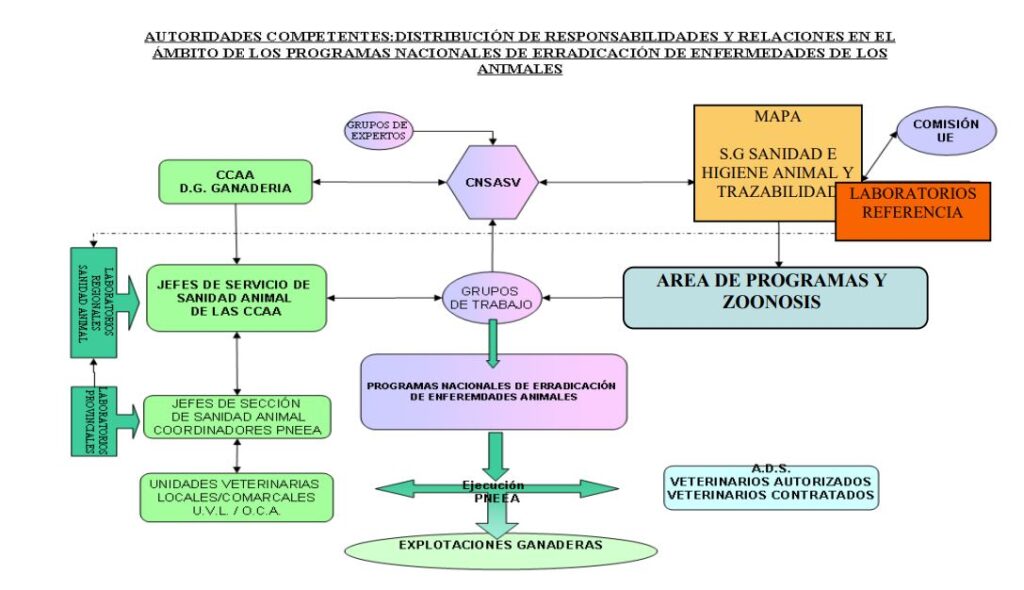
nnnn
13. Vaccination
nnnn- n
- Not mandatory for breeders as a general rule. nnnn
- Only vaccines with a marketing authorisation from the AEMPS or the European Commission may be used. nnnn
- Mandatory for heavy-breed breeders when restocking a house that has previously tested positive: the next flock must be vaccinated before the laying phase. nnnn
- All vaccination must be recorded in the medicines register and in the MAPA computer application. n
nnnn
14. Official feed controls
nnnn- n
- Feed business operators must have a documented HACCP system. nnnn
- Feed must come from registered or authorised suppliers in accordance with Regulation (EC) 183/2005. nnnn
- Each year, more than 3,000 official inspections are carried out at animal feed establishments and more than 1,000 official microbiological samples are taken. nnnn
- In plant-based products: if Salmonella is detected, identification of the serovar is requested; only if it is one of the 5 target serovars is notification made through the Alert Network. n
nnnn
15. Meat management from SE/ST-positive flocks at slaughter
nnnn- n
- The operator must include in the FCI (Food Chain Information) the result of the most recent Salmonella test. nnnn
- SE/ST-positive flocks are slaughtered by means of logistical slaughter (last in the daily order), followed by cleaning and disinfection. nnnn
- Slaughterhouses must include carcasses from these flocks in their sampling plans in accordance with Regulation (EC) 2073/2005. n
nnnn
16. Compensation for owners
nnnn- n
- In the event of compulsory slaughter, owners are entitled to compensation if they have complied with current regulations. nnnn
- The compensation scales are set out in RD 823/2010. nnnn
- The age of the birds for compensation purposes is the age they were at the time the competent authority orders the slaughter. n
nnnn
17. Programme Monitoring System
nnnn- n
- Two IT applications from the MAPA (one for self-checks, one for official control). nnnn
- Double review: the CCAA review data within their territory; the General Sub-Directorate carries out the overall review. nnnn
- Self-check quality control plan: the Official Veterinary Services verify 5% of holdings in each CCAA (minimum 1 farm if there are fewer than 20). nnnn
- Self-check laboratory inspection: each CCAA must have inspected all laboratories in its territory within a period of 2 years. nnnn
- Selection criteria for holdings subject to quality control (in order of priority):n
- n
- Negative self-checks but positive official control. nnnn
- Negative self-checks but positive Public Health notification. nnnn
- Negative self-checks but positive LDD efficacy analysis. nnnn
- Random selection from holdings without official controls. n
n
nnnn
18. Prevalence trends (2007–2024)
nnnn| Year | Prevalence (% adult flocks positive for target serotypes) |
|---|---|
| 2007 (official control) | 2.30% |
| 2008 (official control) | 2.50% |
| 2009 | 3.30% |
| 2010 | 0.72% |
| 2011 | 0.32% |
| 2012 | 0.12% |
| 2013 | 0.39% |
| 2014 | 0.52% |
| 2015 | 0.28% |
| 2016 | 0.43% |
| 2017 | 0.65% |
| 2018 | 0.52% |
| 2019 | 0.41% |
| 2020 | 0.77% |
| 2021 | 0.12% |
| 2022 | 0.36% |
| 2023 | 0.89% |
| 2024 | 0.78% |
In 2024, the most prevalent serotypes were, in order: S. Infantis, S. Enteritidis, monophasic S. Typhimurium, S. Typhimurium and S. Virchow.
nnnn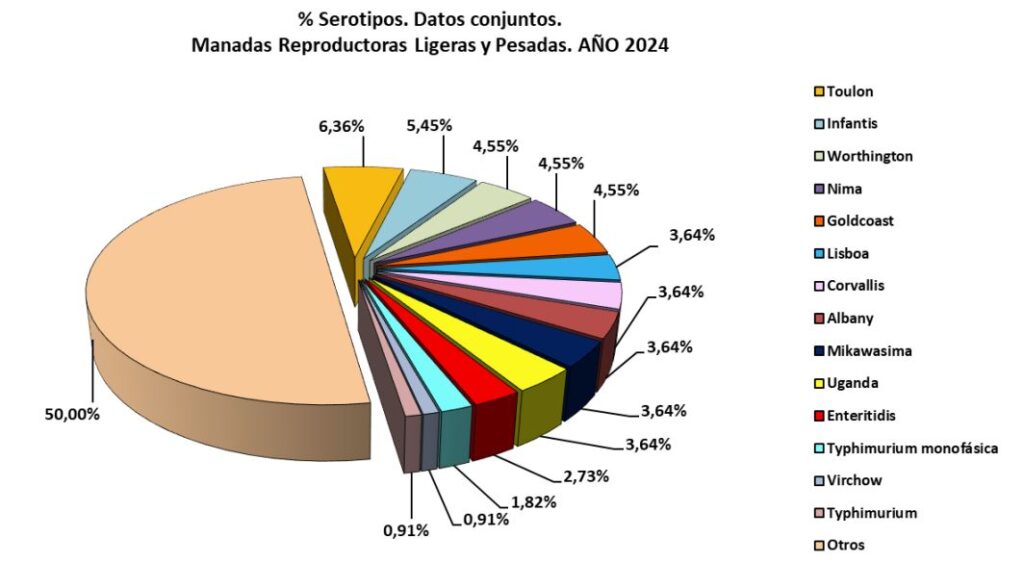
nnnn
19. Animal welfare during health depopulation
nnnnHealth depopulations must comply with Regulation (EC) 1099/2009 on the protection of animals at the time of killing. The Autonomous Communities apply the supplementary animal welfare document for health depopulations published by the MAPA.
nnnnnnnnnnnnnnnnnnnn
List of Salmonella vaccines authorised in Spain (updated June 2025)
nnnnnnnn
Disclaimer / Important notice:
This summary has been prepared by NeXusAvicultura.com based on the official document “National Control Programme for Certain Salmonella Serotypes in BREEDER HENS of the Species Gallus gallus 2025–2027, 2026 Version“, published by the General Sub-Directorate of Animal Health, Livestock Hygiene and Traceability of the Ministry of Agriculture, Fisheries and Food (MAPA).
It is for informational purposes only and does not replace the legal text, which can be consulted in full (46 pages) on the MAPA website.
nnnn
For further information:
-. Salmonella in poultry farming
-. Basic regulations and general information on Salmonella Control Programmes
-. MAPA’s main page on Salmonella Control in poultry
-. Summary of the 2026 Salmonella Control Programme for fattening and breeder TURKEYS. (25 March 2026)
-. Summary of the 2026 Salmonella Control Programme for BREEDER hens. (17 March 2026)
-. Summary of the 2026 Salmonella Control Programme for BROILERS. (23 Feb 2026)
-. Summary of the 2026 Salmonella Control Programme for LAYING HENS. (17 Feb 2026)
nnnn
Want to stay one step ahead in poultry farming?
Subscribe free to our eNewsletter and receive a weekly selection
of the best information to anticipate trends, stay up to date and grow as a poultry industry professional.
NeXusAvicultura: Vision, Insight, Quality and Context.