
F. Javier González González
Veterinarian, Animal Production
Valladolid, 9 March 2026. – I confess that I have always wanted someone to ask me to give a talk on “The future of livestock farming” or “Livestock farming in 50 years’ time” — topics that, at my age (60), carry very little personal risk.
nnnnBut since no one has taken the initiative to commission such a talk, I have decided to take matters into my own hands and put down in writing a few (just a few — no need to worry) reflections on the subject. I have spent more than 35 years working as a veterinarian in animal production and, although it may sound like a cliché, I have seen a great deal happen along the way (perspective, at least, is something I am not short of).
nnnnOnce upon a time…
nnnnBecause to talk about the future, one inevitably has to make some reference to the past. And I can assure you that a great deal has happened over these 35 years. When I started out, there were no restrictions on the use of growth promoters, antibiotics and other compounds capable of turning a poorly managed farm into a profitable livestock operation. Incidentally, boomers and Generation X (mine, by a narrow margin) consumed “everything” (carbadox, olaquindox, chloramphenicol, furaltadone…) and here we still are — with our various ailments, but I very much doubt they have anything to do with all those substances I mentioned; and we are living longer than ever! I say this to reassure anyone who suddenly thinks they have eaten a steak containing 2 ppb of enrofloxacin and is expecting palpitations or something. But that is a topic for another day.
nnnnSmall livestock units, limited mechanisation, feed supplied mostly in sacks, a great deal of veterinary work in both production and health, and no presence yet of the large retail chains that would later come to radically change the production model, and so on.
And then came the EU
nnnnThen came Europe with its regulations and prohibitions; the large retail chains whose sole apparent aim was to sell products more cheaply than their competitors; the Km 0 concept; the White Paper on Food Safety (“From Farm to Fork”); and all of this gradually brought us to the model we now have in Spain and, by extension, in our “old and effete Europe” (no one should be too thin-skinned to take offence at that expression — it is not even mine, but should be understood in the context I mentioned earlier: it comes from someone in Generation X, verging on boomer).
nnnnBut we should not spend any more time on preambles. Because the question is: what now?
nnnnThis is the moment to consult the crystal ball and commit to a position. A spoiler: the primary sector will exist for ever. The question is how.
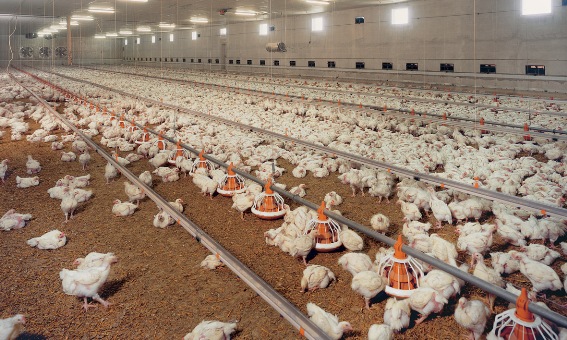
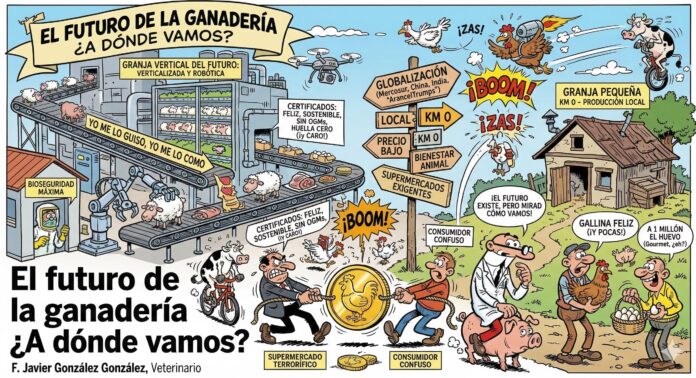
nnnnLet us talk about Spain (and Europe). Two apparently contradictory models coexist: large business operators that are bringing more and more livestock units under their umbrella and that, through natural evolution, are becoming increasingly “vertically integrated”; and, on the other hand, small farms that make Km 0 their banner (I would note here that this was one of the key objectives set by “Europe” in shaping the “future of European livestock farming”).
nnnnThe advantages of one model are the disadvantages of the other, and vice versa. Both models must respond to a demand that (already today, but even more so in the future) goes well beyond the local, regional, national or continental level, and where interactions with the rest of the world will grow ever greater and more apparent (Mercosur, trade agreements with China and India, Trump-style tariffs, etc.).
nnn
Therefore, livestock farming is widening its focus towards new frontiers while at the same time trying to protect its own. And in this no-holds-barred contest, who will come out on top? The comfortable answer is “the usual suspects” — that is, big capital, which will decide at any given moment how to tip the international scales.
nnnnThe less comfortable answer is that consumers will also have a say. Simplifying our criteria “for didactic purposes”, one could say that we buy food (I am focusing here on food of animal origin) first out of necessity (and this is the condition that gives us our advantage and guarantees our future), after which come other factors that each person will rank as their own good judgement dictates (I will try to list them in no particular order; let us see what I come up with): price, safety, animal welfare, locally sourced products, various certifications, carbon footprint, brands…
nnnnnnnnnlivestock farming is widening its focus towards new frontiers while at the same time trying to protect its own.
n
The three possible strategies for the future:
nnnnFrom this point on, and this is an entirely personal view, I will attempt to classify the main operators and their possible future strategies:
nnnnLarge retail chains:
nnnnThey seek and will continue to seek price competitiveness, but at the same time also differentiation from their competitors. They know that such differentiation comes at a cost (to the producer) and may range from new certifications (animal welfare, antibiotic-free, non-GMO, “natural” feeds, happy hens, “sustainable” cows…) to championing locally sourced products with designations of origin, own-label ranges, zero carbon footprint, and so on. And all of this while simultaneously striving to develop better and cheaper private-label products aimed at the mass market.
Until quite recently, the livestock sector feared the guidelines set by these large retail chains more than EU legislation itself. It was the major supermarket chains that first “pledged” not to sell eggs from “caged hens”, ahead of any legislation that, to this day, has still not actually banned cage egg production. The banner was animal welfare, but the reality was nothing more than a marketing strategy (not a particularly effective one, in my humble opinion). But never mind…
The problem these large retail chains are going to face is that there will be fewer and fewer operators capable of meeting their requirements. And the fewer the operators, the greater the negotiating power of those who sell. This is a new development.
nnnnNot so long ago, the purchasing managers of the major chains (people who were feared in my professional circle) knew that there were many sellers competing for their business, which always drove better offers. There was always someone cheaper. That is no longer the case, and large retail is more concerned than ever about securing guaranteed supply — and not just any supply. Competitive prices, yes, but also differentiated products that go beyond own-label ranges.
We all know how difficult it is in the livestock world to build a brand around chicken meat, eggs or cow’s milk, but I have no doubt that this will be one of the avenues to explore. Consumers will gain in quality, but will have to pay more for their food. And all of this subject to the trade agreements I mentioned earlier. We will see what effect Mercosur or agreements with India or China have on supply.
The much-discussed mirror clauses — the same standards and production requirements? One would assume so, but as of today there are still many unanswered questions about how to enforce this in “real life”.
nnnnnIt was the major supermarket chains that first “pledged” not to sell eggs from “caged hens”, ahead of any legislation
n
Large producers:
nnnnLarge, dominant operators capable of negotiating as equals with these major retail chains. A mutual dependency that, in my humble opinion, could prove beneficial for all parties (and here I include consumers as well). Standards of quality and food safety can be raised while, at the same time, economies of scale are leveraged to bring good products to market at competitive prices. Legislative requirements are becoming ever more demanding and complex, which gives these large producers a clear competitive advantage, as they have the structural capacity to meet them (I would note again that this is not without contradiction in a Europe that professes concern for local economies).
In any case, I suppose what matters is being able to eat — or rather, being able to afford to eat (we have quite enough on our plates with housing costs). And what will the strategy of these large producers be?
Almost certainly, first and foremost, to continue growing through both acquisitions and capacity expansions. The “easy” path forward seems to point towards continued vertical integration: the entire production model under single ownership — in other words, “I cook it myself, I eat it myself.”
But at this point I want to at least raise a question. Given the productive structure we currently have, would it not be a better option to seek strategic partners for the various stages of production, rather than owning everything outright?
The advantages speak for themselves: a feed manufacturer is already an expert in making feed; the owner of the genetics or the breeding operations, exactly the same.
If I, as a large company, want to own farms, slaughterhouses, laboratories, veterinary medicines, genetics, rearing facilities, feed mills, veterinary services, legal services, my own commercial operations, and so on, I will need a frankly complex organisational structure and will have no one to blame if things go wrong (I can assure you from experience that this is more than just a joke). And it will always be cheaper to have partners than to own everything outright. If my objective is to sell chickens, my priority must be to have a lot of chickens.
Everything else can be negotiated with companies that specialise in each “leg” of the production-commercialisation chain. Time will tell what the future holds. But, as a veterinarian — and having witnessed the havoc caused and still being caused by Avian Influenza, African Swine Fever and Lumpy Skin Disease — I would put in a word here and highlight the direct correlation between farm size (or production unit size) and biosecurity risk. Be very careful with facility design and biosecurity.
nnnnnnnnnnnnnWould it not be better for large producers to seek strategic partners for the various stages of production, rather than owning everything outright?
n
Small-scale production and local product distribution:
nnnnThis reminds me of what one of my many bosses once said to me: “Javier, I wish we could sell all the feed in sacks. That’s where the real business is.” And yes, in a way — but no. It is as utopian as imagining that every flat on the Castellana should have a cage with three hens and two chickens, and a greenhouse on every terrace with a tomato plant. It is a lovely idea, but… This is not to say, by any means, that there will be no local and highly differentiated production.
It will not be easy for these producers, but Europe is backing them and, if they can organise themselves effectively, they too will have a place in the livestock sector of the future.
Gourmet products are like the tickets that Gila used to sell (a joke only boomers and Generation X will appreciate): I sell them for a million each, and I only need to sell one to have made my afternoon. I mentioned earlier how difficult it is to build a brand around milk or eggs, but it has been achieved in the past and will be something to consider in the future.
Moreover, the advantage for small producers of having large dominant operators is that these players will make it very hard for product prices to fall to loss-making levels. We will start from higher profitability thresholds, and this is good for both large and small producers alike. I have always personally supported small producers and I encourage them here to use their imagination — because motivation they have in abundance — and to persevere in doing what they love in order to make a living from it.
Therefore, and without wishing to go on at length, the primary sector will continue to be the foundation of our — increasingly civilised? — pyramid. There is a future and, with the permission of geopolitics (these days, any article that fails to include that buzzword is no article at all) and of wars, we will continue to put ever higher-quality protein on everyone’s plate (nothing is more democratic than food), while deepening our commitment, as we inevitably must, to everything related to improving animal welfare and sustainability. Not so that the planet outlasts us, but so that we outlast it. A little humility, please. And by the way, despite all the criticism — past, present and future — I feel more privileged than ever to have been born in old Europe.
nnnn
F. Javier González González
Veterinarian, STC Nanta
See other articles by this author
OPINION articles published in NeXusAvicultura are always signed and reflect the personal views of the author, not necessarily those of the organisation or company they work for, nor those of this poultry media outlet.
nnnn
Want to stay one step ahead in poultry?
Subscribe free to our eNewsletter and receive a weekly selection
of the best information to anticipate trends, stay up to date and grow as a poultry professional.
NeXusAvicultura: Vision, Insight, Quality and Context.