
Geopolitical tensions between the U.S., Israel and Iran are disrupting poultry trade logistics and testing the responsiveness of Brazil’s animal protein supply chain
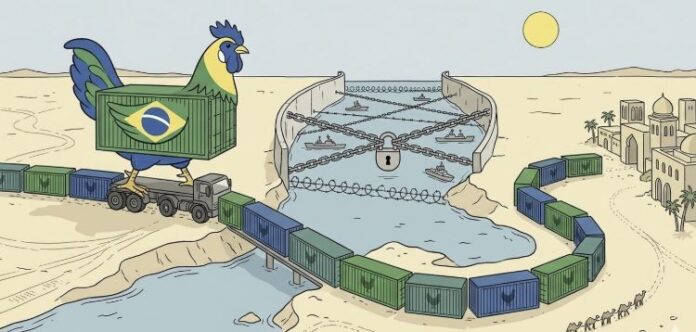
The closure of the Strait of Hormuz, a direct consequence of the escalating conflict between the United States, Israel and Iran, is forcing Brazilian chicken exporters to redesign their logistics routes to the Middle East. This was confirmed by Ricardo Santin, president of the Brazilian Animal Protein Association (ABPA), in statements to the Brazilian newspaper Valor Econômico.
“30% of Brazilian chicken exports are destined for the Middle East. This is not a marginal market: it is a pillar of global poultry trade.”
The region is critical for the Brazilian poultry sector. The twelve countries in the area (excluding Iran) import between 100,000 and 120,000 tonnes of Brazilian chicken meat per month, representing approximately 15% of Brazil’s total production. More than half of the chicken imported by Saudi Arabia comes from Brazil; in the United Arab Emirates, that proportion rises to 74%.
Three alternative routes in search of continuity
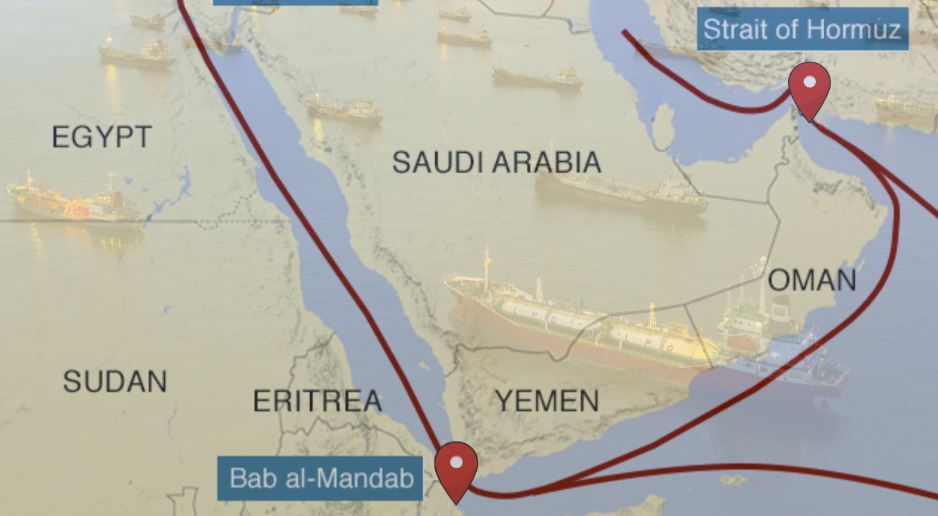
Faced with the blockage of the usual access through the Strait of Hormuz, logistics operators have activated at least three alternative corridors to maintain the flow of shipments:
Strait of Bab al-Mandab: the passage between Yemen and Djibouti connecting the Red Sea with the Gulf of Aden, enabling access to the Saudi coast.
Port of Salalah (Oman): from there, cargo is transported overland to Dubai.
Port of Khorfakkan (UAE): on the eastern coast of the Emirates, before the strait, accessible via an operator that has begun receiving cargo in recent days.
“Companies in the sector are mobilising teams, logistics networks and international partners to maintain the flow of food. New routes are being assessed and operations are being adjusted on a daily basis.”
Price impact: contained for now
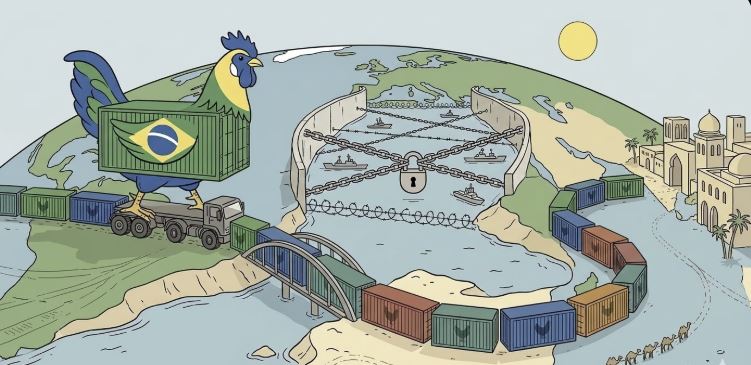
According to Ricardo Santin, the volume of chicken exported to the region is relatively small compared to Brazilian domestic consumption (approximately 900,000 tonnes per month), meaning that any eventual redirection of those shipments to the domestic market would not put significant downward pressure on prices. Nevertheless, he warned that if the situation is prolonged, a price impact could begin to be felt.
No reductions in poultry slaughter are anticipated for the time being, nor any adjustments to the already scheduled placement of breeding stock.
“If this situation continues for a long time, then yes, there could be a price drop.” — Ricardo Santin, ABPA
ABPA has requested that Brazil’s Ministry of Agriculture modify export documentation requirements so that cargo destined for the Middle East can be redirected to alternative ports without the need to reissue certificates. At the time of the original publication, the Ministry had not yet issued an official response, although Santin indicated that the institutional stance was one of facilitation.
The importance of having Plan B and Plan C
This situation serves as a reminder of two things: the importance of food sovereignty for individual countries, and the vulnerability of global poultry trade to its dependence on maritime corridors that can be closed by unpredictable geopolitical factors. Poultry companies engaged in export must maintain up-to-date contingency plans in a highly volatile global environment.
The episode also underscores the importance of multinational scale in times of crisis. Companies with geographically diversified operations — as we recently analysed in our article on Global Eggs — have the flexibility to redistribute volumes and mitigate localised disruptions, a competitive advantage of growing value in this new geopolitical landscape.
Sources:
-. Valor Econômico, ABPA, NeXusAvicultura analysis
Want to stay one step ahead in poultry?
Subscribe free to our eNewsletter and receive a weekly selection
of the best information to anticipate trends, stay up to date and grow as a poultry professional.
NeXusAvicultura: Vision, Insight, Quality and Context.