
F. Javier González González
Poultry specialist veterinarian, Nutreco.
As if we didn’t have enough already…
After a particularly intense year from a health perspective in the poultry sector — marked by Avian Influenza — another virus, a long-familiar one, is once again taking centre stage. Its reappearance — the causes of which would merit a thorough analysis — is having a significant impact across the European Union and, most notably, in Spain. We are, of course, talking about Newcastle Disease (ND).
With Poland leading the way with more than 90 outbreaks in commercial poultry over the past two years, almost all in vaccinated chickens and turkeys, followed by Germany and Spain — where, as of the date of writing this article (29/04/26), nine outbreaks have been declared, all in the Valencia region and with a clear interdependence between primary and secondary foci. The most recent official case was declared on 28 April in the same Valencian municipality where two previous outbreaks had already been reported, in 28-day-old broiler chickens that had been vaccinated three times (it should be recalled that vaccination has been mandatory in the Valencian Community since February of this year).
This example makes it abundantly clear that vaccination is not the solution, but it can undoubtedly be part of one. In this brief article we will attempt to outline the pros and cons of this practice which, when it comes to animal and human health in general, remains the best preventive option against infectious processes, particularly viral ones.
First, it is worth recalling that, like Avian Influenza, Newcastle Disease (ND) is notifiable throughout the European Union and is classified as a Category A disease, which means that the regulatory objective is immediate eradication upon detection, entailing the culling of affected flocks and the establishment of surveillance and protection zones.
It is a viral disease and therefore infectious and highly transmissible. As a consequence, biosecurity measures aimed at preventing the virus from entering farms remain — as in the case of the influenza virus — the “gold standard” tools for attempting to control the disease: management of visitors, wild birds, rodents, vehicles, etc.
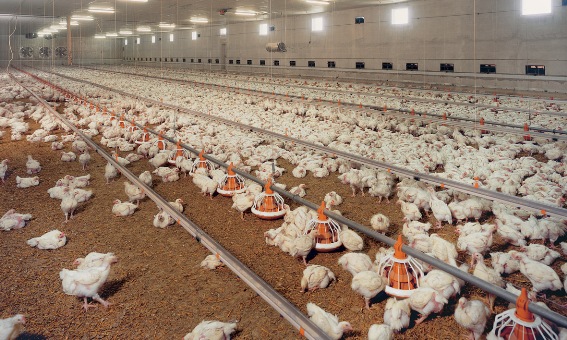
The way it has emerged in Spain once again draws attention to the health risks posed by large production units and by high poultry densities in certain areas (one need only look at how it appeared and how it has spread in Spain). The logistical and economies-of-scale benefits are clear, but so too is the elevated health risk. A topic for another article.
In the case of ND, vaccination is not mandatory in the EU, although it is a widespread practice throughout the poultry sector. It is regarded as a complementary tool but is by no means the cornerstone of disease control.
Exceptionally, countries (as in the case of Poland) or regions (as in the case of the Valencian Community in Spain) may request the temporary mandatory use of the vaccine in response to recurring outbreaks, but this is clearly not sufficient on its own.
Pros and cons of vaccination
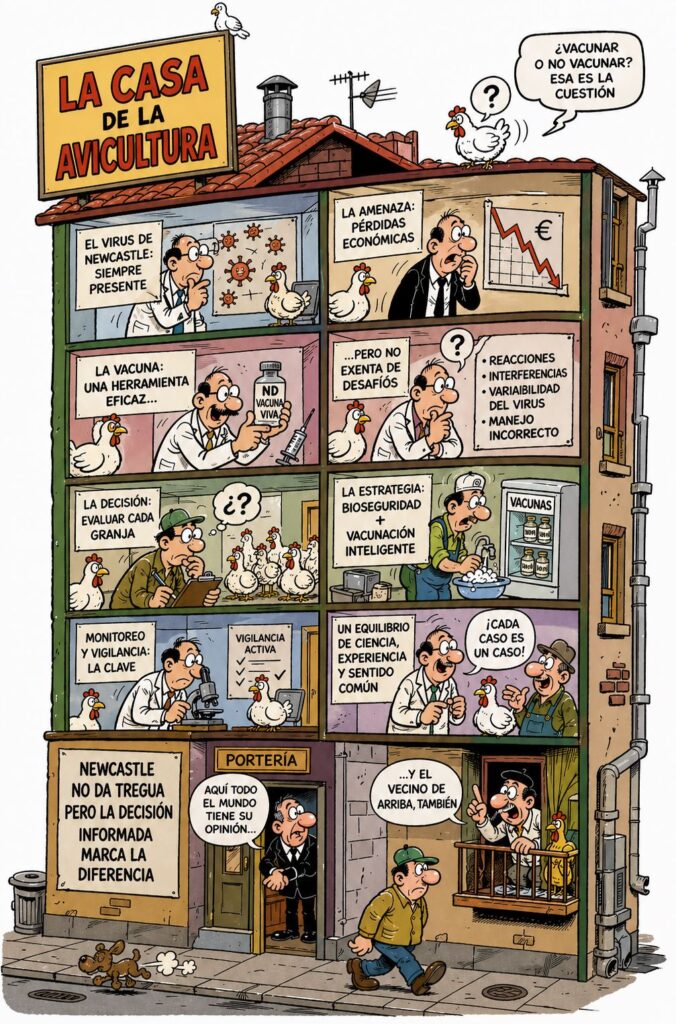
Let us consider the arguments in favour of using vaccines (as advocated by the countries and regions where ND is present):
- Reduces mortality and clinical signs.
- It is an indispensable tool in areas where the virus circulates endemically.
- Live vaccines are available that are easy to administer in the field.
And now let us consider the arguments against (as advocated by disease-free countries and, in general, by the European authorities):
- Classical vaccines do NOT prevent infection or viral shedding — they only prevent clinical signs.
- There is a high risk of silent circulation and a false sense of security.
- Negative impact on health status and international trade.
- Antigenic variability of the strains involved.
- Difficulty in differentiating between vaccine virus and field virus.
An additional problem — and in my view as a veterinarian the most significant one — is the considerable difficulty of designing an effective vaccination programme. It is clear that any programme must be tailored to the type of poultry production, taking into account variables such as maternal immunity, productive lifespan, genetic value, and health status of the birds. Vaccinating broiler breeders (meat or layer type), laying hens, turkeys, broilers, game bird farms, or backyard poultry (subsistence flocks) are not equivalent situations. The greatest challenges arise with subsistence flocks (multi-age populations, difficulty of homogeneous administration, contact with wild birds, etc.) and with broilers (short production cycle, interference with maternal antibodies as seen with Gumboro, etc.). As already noted, there is clear evidence of clinical outbreaks in vaccinated broilers in Poland, Belgium, and Spain (including the most recent case reported yesterday).
In all cases, it is essential to carefully evaluate the types of commercial vaccines available. To summarise briefly: we have live vaccines administered by spray or drinking water, inactivated vaccines that are injected, and vectored vaccines (only two of which are commercially available in Spain). I would particularly highlight the latter, which are administered in hatcheries and do not interfere with maternal immunity, making them the apparent vaccine of choice for broilers. They also offer the advantages of not causing post-vaccination respiratory reactions (which are very common with live vaccines), providing immunity that is slow to develop but highly stable and long-lasting, and significantly reducing — though not completely eliminating — viral shedding. In areas of high infectious pressure, they therefore need to be reinforced with live vaccines.
Consequently, there is no single “best vaccination programme against ND”; it must be adapted to each production type, risk level, and epidemiological context.
We close by pointing to the same debate that arises with Avian Influenza: control versus eradication. In both cases, vaccines are an excellent instrument for control (when programmes are well designed and vaccines correctly administered), but they are “enemies” of eradication, which remains, for the time being, the objective set by the EU for both diseases. How this evolves will no doubt depend on the progression of these diseases and their consequent economic impact.
One further important consideration: the rigorous implementation of biosecurity measures helps prevent the spread of disease and protects both human and animal health. It is the ideal tool for both the control and the eradication of infectious diseases. Moreover, sound biosecurity helps prevent economic losses in productive sectors, ensures food safety, and protects ecosystems.
We must work harder and smarter on this front.
F. Javier González González
Veterinarian, STC Nanta
See other articles by the author
The OPINION articles published in NeXusAvicultura are always signed and reflect the personal views of the author, not necessarily those of the organisation or company in which they work, nor those of this poultry media outlet.
Want to stay one step ahead in poultry production?
Subscribe free to our eNewsletter and receive a weekly selection
of the best information to anticipate trends, stay up to date, and develop as a poultry industry professional.
NeXusAvicultura: Vision, Expertise, Quality and Context.